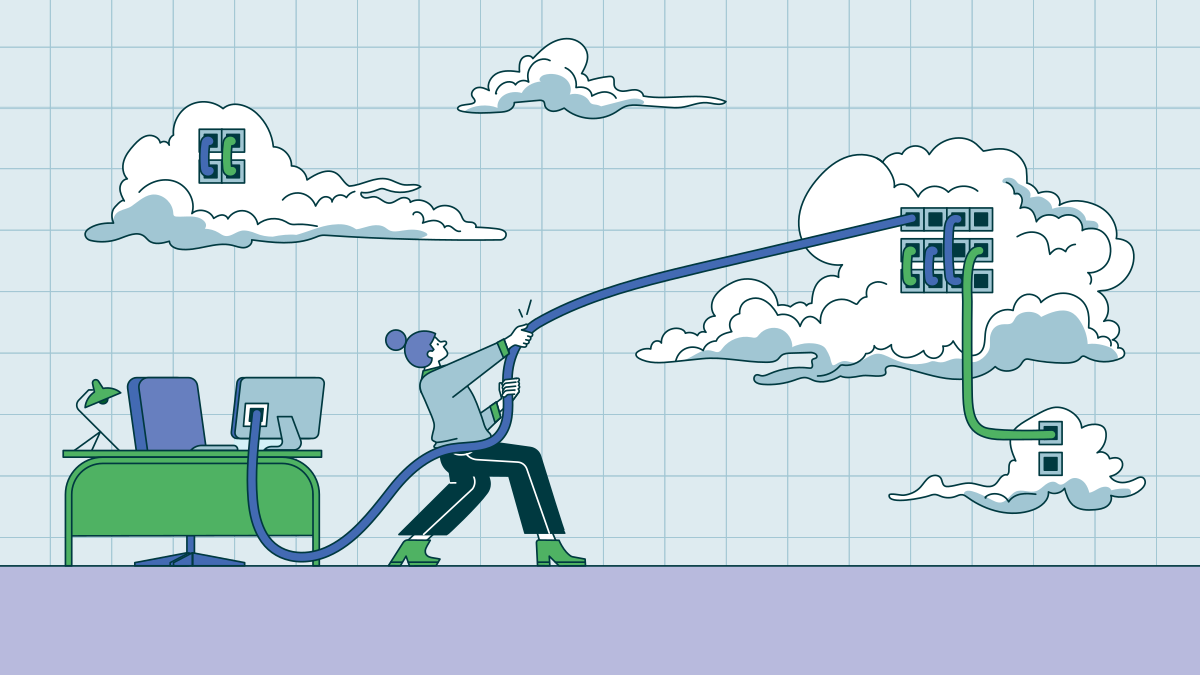
Cloud computing was once the natural option for enterprises, shaping the way systems are structured and run, shifting workloads to hyperscale platforms. However, issues around rising costs, geopolitical uncertainty, and data residency regulations are forcing tech leaders to claw back control.
Cloud repatriation from dominant vendors like AWS, Google Cloud and Microsoft can return operational and jurisdictional control to organisations. It also helps businesses avoid hidden costs within the Big Three vendor trap. Systems are easy to build on these platforms, but they often rely on proprietary databases, AI services and analytics tools that suffer from unpredictable costs and outages.
James Lovegrove, public policy director (EMEA & APAC), Red Hat, says EMEA leaders are increasingly focusing on digital sovereignty, where the legal and technical capacity to audit, modify and secure one’s own environment, according to regulatory requirements, is retained.
“EMEA leaders are moving beyond the cloud efficiency drive to a compliance and resilience mandate, both in response to regulatory and wider policy trends and as part of their business logic,” he says.
“Over-reliance on a single proprietary provider can undermine an enterprise’s ability to compete as well as comply with EU regulations or qualify for future procurement opportunities in the region. Location of data is a risk factor, but more importantly organisations are seeking to preserve operational autonomy.”
The sovereignty premium
The move towards digital sovereignty is already ramping up. Gartner forecasts that sovereign cloud infrastructure as a service (IaaS) spending will shift 20% of current workloads from global to local cloud providers. At the same time, global sovereign cloud IaaS spending is expected to hit £60.bn ($80bn) this year, representing growth of 35.6% year-on-year. In Europe alone, growth could increase by 83% in the same period.
Clearly, digital sovereignty is driving major shifts in enterprise structure investment. But is sovereignty cost-effective? Analysis carried out in 2025 by BCG Global indicates that sovereign cloud options come with premiums of 10-30% compared with public cloud offerings. This is because of compliance controls, isolated infrastructure and region-specific staffing. Therefore, sovereignty is likely to increase short-term infrastructure costs while reducing long-term strategic exposure.
When the cost of leaving the cloud becomes too high, the benefits of hyperscale diminish. This ‘lock-in threshold’ is the point at which the cost of moving data, modifying applications and reskilling employees exceeds the savings that cloud services promised.
Provider-specific tools such as analytics, AI services, managed databases and frequently accessed datasets make migration pricier yet. And, the more embedded in the cloud an enterprise is, the more complex the problem. Transferring data can cause operational disruption, delays, and involve hefty fees.
One third of organisations plan to move more workloads into on-premises
Emma Lauchlan, Asanti Data Centres
To retain flexibility and keep reaping the benefits of hyperscale and cloud innovation, CIOs and CFOs must be clear about this tipping point and recognise just how locked in they are. They can then choose which data-heavy, more predictable, latency-sensitive systems can be shunted to edge or private systems where costs are easier to control.
Emma Lauchlan, director of growth at Asanti Data Centres, says: “Leaders are drawing a clearer line between workloads that can move for efficiency and those that need to remain in tightly governed environments to meet GDPR, sector regulation and customer expectations around privacy and trust. It is one reason why a third of organisations plan to move more workloads into on-premises or UK colocation environments, so they can retain a higher degree of control over where data resides and how it is protected.”
When it comes to cost savings, cloud repatriation is often positioned as a move from OpEx to CapEx but the reality is not cut and dried.
Dean Garvey-North, CTO of Microlise, explains: “Cloud shifts the investment focus toward innovation rather than infrastructure management. However, edge should be viewed as complementary to hyperscale cloud rather than a replacement. CapEx typically increases due to hardware procurement, facilities, and infrastructure lifecycle management. Operational complexity and staffing requirements rise, often offsetting perceived OpEx savings. The ability to scale elastically and innovate quickly can be reduced.”
Splitting edge and cloud platforms
The true value for most companies lies not in owning infrastructure but in the software, platforms, and data they build on top of it, he adds, advocating a hybrid model whereby edge is in place for real-time operational intelligence and cloud is deployed for data platforms, AI training and large-scale analytics.
But, what exactly comprises a sovereign tech stack in the current regulatory environment? Control of the full dependency chain is key. Wayne Scott, GRC solutions lead at Escode, says sovereignty depends on independent access to critical applications regardless of where the supplier is headquartered, clear legal rights across the software supply chain, the ability to validate and rebuild software if a vendor fails, and transparency over where applications sit and who ultimately governs them.
You can have data sitting in the right jurisdiction, but still be completely dependent on a supplier you can’t exit or replace
Wayne Scott, Escode
“Also, it’s not just about data residency anymore,” he says. “You can have data sitting in the right jurisdiction, but still be completely dependent on a supplier you can’t exit or replace. Regulators are starting to look beyond location and ask whether firms can actually continue operating if that supplier fails, withdraws or is no longer viable.”
It is no longer an ‘if’ but rather a ‘how’ enterprises achieve that hybrid sweet spot between hyperscale and edge that limits risk and dependency, and maximises innovation. A new, resilient infrastructure will live or die on the ability of CIOs and CFOs to assess long-term value coupled with risk, where factors such as cloud cost, the impact of outages, price rises, and the difficulty of moving workloads fall under their control.
As Garvey-North puts it: “Edge computing brings intelligence closer to operations, but the real power of AI comes from aggregating data at scale. The future isn’t edge or cloud, it’s an architecture that intelligently combines both.”
Cloud computing was once the natural option for enterprises, shaping the way systems are structured and run, shifting workloads to hyperscale platforms. However, issues around rising costs, geopolitical uncertainty, and data residency regulations are forcing tech leaders to claw back control.
Cloud repatriation from dominant vendors like AWS, Google Cloud and Microsoft can return operational and jurisdictional control to organisations. It also helps businesses avoid hidden costs within the Big Three vendor trap. Systems are easy to build on these platforms, but they often rely on proprietary databases, AI services and analytics tools that suffer from unpredictable costs and outages.
James Lovegrove, public policy director (EMEA & APAC), Red Hat, says EMEA leaders are increasingly focusing on digital sovereignty, where the legal and technical capacity to audit, modify and secure one’s own environment, according to regulatory requirements, is retained.