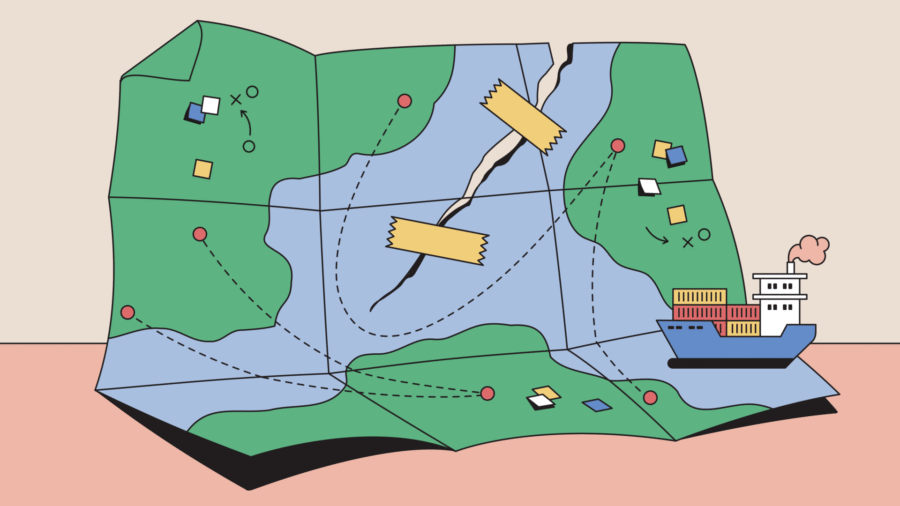
Geopolitics has become a powerful driver of corporate strategy. Western efforts to reduce economic dependence on China and curb its technological rise have unleashed waves of subsidies, tariffs and export controls, forcing multinationals to rethink where and how they operate. A survey by the EU Chamber of Commerce in China found that 26% of multinationals are planning fully or partially separate supply chains for their China business.
Meanwhile, Russia’s invasion of Ukraine has accelerated the push for supply-chain resilience, encouraging firms to move production closer to home or into allied markets. And the Trump Administration has pressed foreign multinationals to increase US investment while imposing and expanding sweeping tariffs across industries.
In 2025, the Economic Policy Uncertainty Index reached a 20‑year peak, surpassing historic highs during the 2008 financial crisis and the Covid‑19 pandemic. Senior executives now cite geo‑economic confrontation as the most urgent threat to business operations, according to the World Economic Forum’s Global Risks Report 2026.
For decades, globalisation allowed companies to optimise for efficiency, scale and cost. Today, those advantages risk being steadily eroded by political risk, regulatory barriers and security-driven intervention that shape where companies invest and whom they can sell to. Navigating this new, volatile reality will require a fresh approach from the C-suite.
Background risk to boardroom priority
For many companies, this level of global upheaval is still new, says Simon J. Evenett, professor of geopolitics and strategy at IMD Business School. “Many spent 2025 trying to make sense of the dynamics which had been unleashed. I expect that in 2026, many corporate boards and senior executives will begin revising their companies’ global footprint.”
Security concerns dominate public policymaking towards business
While sectors such as mining and energy have long monitored government decisions, geopolitics presents a more complex challenge. “National politics is not the same as geopolitics,” Evenett says. “The intensity and unpredictability of state-to-state relations over the past decade have forced many companies to question whether their internal expertise is sufficient.”
Traditionally, companies have relied solely on the C-suite and board members’ experience and networks to assess national rivalries. Today, many are moving toward a more systemic approach: tracking trade risks, evaluating exposure and opportunities, and briefing executives and boards regularly as cross-border trade becomes increasingly politicised and conflict-prone.
“Many companies have sought to create informal mechanisms and networks of talent within their organisations that are developing a stronger sense of geopolitical dynamics,” says Evenett.
Capability gaps
Still, formal structures remain rare. According to a new white paper by IMD Business School, the World Economic Forum, and Boston Consulting Group’s Center for Geopolitics, fewer than one in five firms (20%) have a dedicated geopolitics department.
The report, drawing on interviews with 56 senior executives across industries and regions, found that while leadership awareness of geopolitical risk is high, most companies continue to treat such risks as one-off challenges rather than an ongoing strategic priority.
Many companies question whether their internal expertise is sufficient
Processes linking geopolitical developments to business metrics and operational decisions are limited, and in many firms, assessment is fragmented across legal, compliance, government affairs, and strategy teams rather than integrated into core planning.
“Some organisations have deliberately avoided creating standalone geopolitics units, fearing they would become detached from commercial reality,” says Evenett, who co-authored the report. The challenge, he continues, lies in combining deep political insight with practical commercial integration. “A period of experimentation is underway, as companies try to find the best organisational configuration to advance their commercial interests in an era of security-driven policymaking.”
Balancing insight with impact
A dedicated geopolitical function has its advantages. But for companies to sustain investment in these units, they must avoid creating the impression that they are merely cost centres. “They must go beyond risk management,” Evenett stresses. “No one gets much credit for bullets which are correctly anticipated and dodged. Instead, looking at global upheaval and spotting opportunities which can then be captured successfully by companies is a much better way for a geopolitical department to demonstrate its value.”
Many companies choose not to appoint former public officials to lead their geopolitical functions, Evenett adds. Instead, they rely on a long-standing executive who understands how different business units within a group create value, how a strategy comes together and how to communicate and network effectively across the organisation.
Internal credibility, he continues, is as critical as external expertise in ensuring geopolitical insight informs real business decisions.
A permanent feature of corporate life
Geopolitical pressures are here to stay, Evenett warns. “The battle for primacy between the United States and the Soviet Union lasted over 40 years. It took the Americans 15 years to overcome the challenge from a rising Japan in the 1980 and 1990s. I expect that the rivalry between the United States and China will go on for decades.”
As the world moves from an era of American hegemony and other countries seek to assert themselves in their regions, security-driven business upheaval will be a first-order consideration for senior executive teams and boards for decades to come, he adds.
For corporate leaders, that means geopolitical analysis can no longer sit at the margins of strategy. Decisions about plant location, supplier choice, customer exposure and technology architecture increasingly carry political as well as financial consequences.
“That holiday from history is over and now we return to an era where security concerns will dominate public policymaking towards business and trade,” Evenett says. “Those executives and analysts like myself, who came of age in the years after the fall of the Berlin Wall, will need to reset our assumptions and learn to accommodate a wider range of considerations that will reshape global business.”
As security-driven policymaking becomes a permanent feature of the global business landscape, boards and executives must integrate geopolitical insight into core strategy or risk being caught unprepared in an increasingly fragmented and uncertain world.
Geopolitics has become a powerful driver of corporate strategy. Western efforts to reduce economic dependence on China and curb its technological rise have unleashed waves of subsidies, tariffs and export controls, forcing multinationals to rethink where and how they operate. A survey by the EU Chamber of Commerce in China found that 26% of multinationals are planning fully or partially separate supply chains for their China business.
Meanwhile, Russia’s invasion of Ukraine has accelerated the push for supply-chain resilience, encouraging firms to move production closer to home or into allied markets. And the Trump Administration has pressed foreign multinationals to increase US investment while imposing and expanding sweeping tariffs across industries.
In 2025, the Economic Policy Uncertainty Index reached a 20‑year peak, surpassing historic highs during the 2008 financial crisis and the Covid‑19 pandemic. Senior executives now cite geo‑economic confrontation as the most urgent threat to business operations, according to the World Economic Forum’s Global Risks Report 2026.