AI is rapidly reshaping the skills employees need to succeed. But in some cases the systems used by organisations to evaluate performance have failed to keep pace.
At the same time, employers are urging workers to prioritise people skills, such as critical thinking, judgement and communication. In fact, more than two thirds (67%) of business leaders now say they value soft skills more highly than educational qualifications when hiring, according to research by Indeed. Yet few organisations have objective, standardised ways to define, measure or embed these capabilities into meaningful talent decisions.
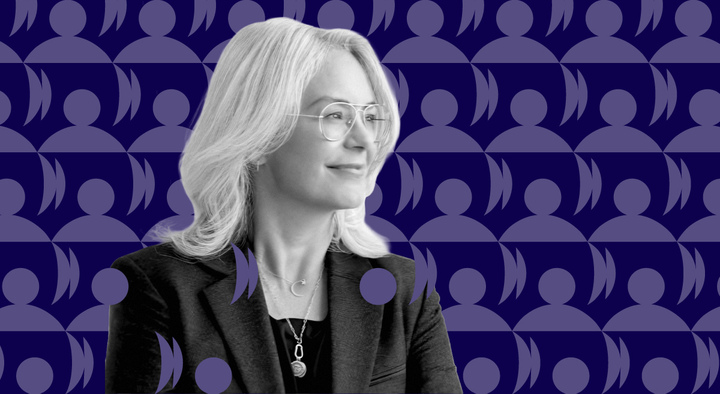
These are precisely the challenges Ali Bebo set out to address as CHRO at Pearson. Six months ago, she began rebuilding the company’s performance system from the ground up, describing the existing approach as “outdated” and “leaving employees blind to their growth potential”.
“It was a system built when Pearson was primarily a publishing company,” Bebo says. “But as we looked at where we wanted to go – becoming the world’s leading learning technology company – it became clear we didn’t have enough clarity around the roles we needed, whether that was in engineering, customer success or digital product.”
A GPS for careers
In response, Bebo and her team have designed what she calls a “GPS navigation system” for careers, a framework that allows employees to see not just where they are today, but exactly what it takes to move forward. This is especially important in today’s AI-driven world, Bebo notes, where jobs are constantly evolving, and employees can no longer rely on static skills descriptions or vague career paths. “Our GPS shows people how to get from point A to point B, and what’s required at every step along the way.”
Unlike the company’s previous “haphazard” approach, Bebo says the new performance system maps every role in detail, defining what success looks like in practice. That includes clear role expectations, the specific skills required and the core behaviours expected of all employees. “That level of clarity simply didn’t exist consistently before,” Bebo says. “People didn’t always know what good looked like, or how to progress.”
We didn’t have enough clarity around the roles we needed
To measure and improve performance, Pearson has introduced a four-phase learning and development framework. It begins with diagnosing roles to identify the skills that matter most. Learning is then embedded directly into the flow of work, rather than treated as a separate activity.
One example of this is Communications Coach, an AI agent embedded in Pearson’s Microsoft Teams, that offers real-time feedback on professional communication. “It assesses clarity, range of expression and how ideas are built,” Bebo explains. “Employees receive a one-to-five-star score, alongside immediate guidance on aspects such as pronunciation and structure.
For the third phrase, progress is evaluated through psychometric assessments that measure employee development against a proficiency scale, before prioritising the skills likely to have the greatest impact on individual growth.
Together, the four phases form what Bebo describes as a “transparent, actionable performance ecosystem” – one designed to help employees navigate their careers with confidence while reinforcing a culture of continuous learning.
Making careers tangible
Crucially, Pearson has also changed how it communicates career progression. Rather than launching the new framework through dense documentation, the company published a series of career stories featuring real employees, from managers to executives, many with more than a decade at the company.
By sharing how people navigated their careers before a formal framework existed, the stories create a clear contrast with the new system and demonstrate how much more intentional career planning can now be. “Career frameworks only work if people can see themselves in them,” Bebo says. “Storytelling makes it real.”
The three ‘power skills’
Firms today are faced with an ever-growing list of skills and little consensus on how to define or measure them. Demand for people skills, in particular, has risen sharply, yet few organisations have consistent ways to assess these capabilities in practice, Bebo stresses.
Against this backdrop, her team have opted for focus over breadth. “Rather than trying to boil the ocean by cataloguing every desirable capability, we identified three core power skills that underpin high performance.”
The first is learning to learn. Bebo describes it as a “force multiplier” that accelerates the development of all other skills. “Once people build the habit of learning,” she says, “they can pick up everything else faster”.
Career frameworks only work if people can see themselves in them
The second is adaptability. In a market defined by constant change, Bebo sees adaptability as a proxy for organisational resilience – the ability to pivot, absorb disruption and continue to perform.
The third is AI literacy. At Pearson, this goes far beyond basic chatbot use. “We want employees to understand how AI works, how it’s governed, and ultimately how to build and work with their own large language models,” she says.
Together, the three skills form the backbone of Pearson’s vision for a workforce equipped to thrive in an AI-driven economy.
Advice to CHROs
For HR leaders grappling with similar challenges, Bebo stresses the importance of starting with roles, not abstract skills. At Pearson, teams analysed roles alongside workflows to understand which tasks would be automated, augmented or fundamentally changed by AI.
“If you understand the design of a role,” Bebo says, “you can identify the two or three skills that genuinely build resilience, instead of overwhelming people with everything at once.”
Traditional long-term planning, anchored in annual or even 18-month cycles, is no longer fit for purpose. According to Bebo, the rapid pace of global change has rendered these timelines obsolete. As new technologies and products emerge at unprecedented speed, leaders can no longer afford the luxury of distant forecasts. Instead, HR leaders must recalibrate their thinking to operate in six-month increments, she says.
This shift reflects a deeper change in leadership philosophy. Rather than attempting to “think their way into the right acting,” today’s leaders must “act their way into the right thinking,” Bebo explains. Shorter planning horizons allow organisations to test, learn and adjust in real-time, an approach far better suited to an era defined by AI disruption and constant technological evolution.
AI is rapidly reshaping the skills employees need to succeed. But in some cases the systems used by organisations to evaluate performance have failed to keep pace.
At the same time, employers are urging workers to prioritise people skills, such as critical thinking, judgement and communication. In fact, more than two thirds (67%) of business leaders now say they value soft skills more highly than educational qualifications when hiring, according to research by Indeed. Yet few organisations have objective, standardised ways to define, measure or embed these capabilities into meaningful talent decisions.
These are precisely the challenges Ali Bebo set out to address as CHRO at Pearson. Six months ago, she began rebuilding the company’s performance system from the ground up, describing the existing approach as “outdated” and “leaving employees blind to their growth potential”.