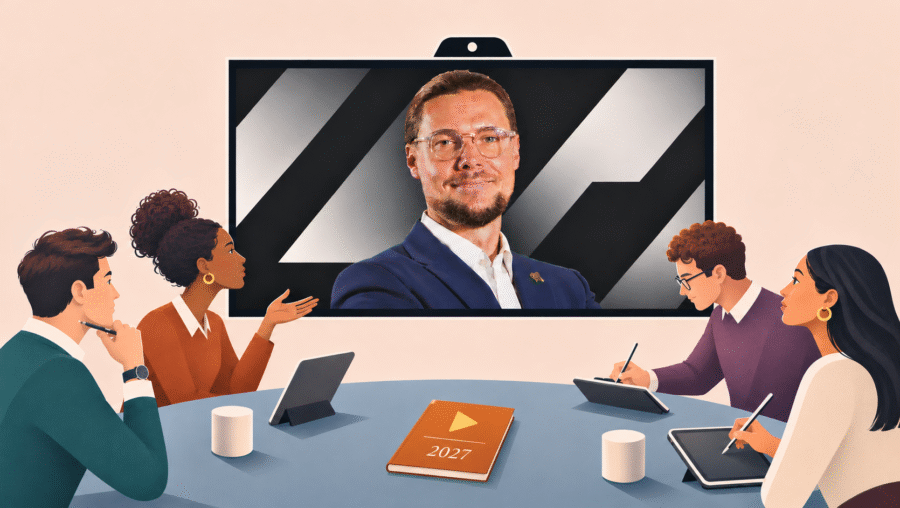
Tim Stoddard looks forward to a return to normality every year, and every year, something gets in the way. “I think normal doesn’t exist anymore,” says the Zebra Technologies senior vice-president for Europe, the Middle East and Africa (EMEA). Sometimes it is geopolitical upheaval, sometimes an economic shock.
Stoddard’s approach is to make sure Zebra can respond quickly, rather than count on the next year being any more predictable than the last.
Disrupt before you’re disrupted
At Zebra, whose technology supports retail, manufacturing and logistics operations, Stoddard measures progress with a simple mantra: Better every day.
“The whole concept behind it is this continuous improvement theory, you know, being 1% better every day,” he explains, which also means questioning established ways of working — even when the business is performing well. “We have to disrupt ourselves before someone else disrupts us.” Stoddard knows competitors will always be looking to take market share. But he is reluctant to describe that as added pressure.
“Pressure is what you create around it,” he says. “More so than ever we have to be agile.”
Zebra’s third-quarter sales rose 22.3% year on year, with EMEA sales up 13%, helped by demand from large transport and logistics customers. Stoddard believes one of the biggest changes in recent years has been in the people buying the company’s products.
“There was a time where, from a technology perspective, we were the experts and we were educating,” he recalls, but customers now have access to considerably more information and arrive with different expectations. “Our role has had to shift quite dramatically in terms of thinking about being more consultative, thinking about where we can create value in a workflow.”
Prove it on the frontline
“One of the biggest challenges that our customers are facing today is labour,” Stoddard says. “So that could be cost of labour, it could be retention of labour, it could be training time of labour, it could be acquisition of labour.” For businesses with large frontline workforces, these pressures are influencing investment decisions, particularly where recruitment, training and employee turnover are costly.
He believes automation can help, although he challenges the assumption that it necessarily means replacing workers.
“For me, AI and automation is all about how we enhance the employees’ journey and enable them to do the highest value tasks,” he says. That might mean reducing repetitive work or giving employees quicker access to the information they need.
Zebra’s radio-frequency identification technology has helped transform stocktaking at JD Sports. A task that previously required 10 employees working eight hours can now be completed by one in approximately 25 minutes, according to technology partner Renovotec.
It is not an AI project, but the time saved is easy to measure. Stoddard believes businesses should demand similar clarity from their AI investments.
“I think about identifying one or two clear problems to solve with a clear return on investment,” he says.
He has seen customers encounter difficulties when they try to solve several problems simultaneously, hoping the combined benefits will justify a larger investment. His preference is to establish the value of one or two applications before attempting something more ambitious. But getting the technology right is only half the job.
“We shouldn’t underestimate the importance of taking employees and colleagues on the journey with you,” he stresses. Staff involvement, training and change management all influence whether an investment delivers its promised benefits.
When regulation creates demand
European regulation presents another challenge, but Stoddard sees opportunities alongside the added requirements.
“A lot of these legislative changes are driving demand in some cases,” he says, pointing to digital product passports, which are designed to make product information more accessible and traceable. Certain batteries are due to require passports from 18 February 2027 under the EU’s regulatory framework. For a company whose technology helps businesses track assets and inventory, such requirements can create demand.
“We’re actually seeing that legislation create opportunity for us through value chain transparency,” Stoddard says. Responding to these changes requires early awareness of regulatory developments and the flexibility to adapt products and commercial strategies. Stoddard regards both as important parts of Zebra’s preparations for 2027.
The investment test for 2027
“I think it’s hard to say what to stop spending money on,” he admits, when asked what UK and European business leaders should stop spending money on next year. Reluctant to name any particular technology, he would rather see executives concentrate on the operational problems they need to address, and then establish which investments offer a clear return.
Trusted technology advisers also have a role to play. Stoddard believes close partnerships allow businesses to test applications, demonstrate their value and gradually expand into other areas.
Zebra’s ambitions for 2027 include becoming a leader in frontline AI, bringing intelligent assistance directly into the devices and everyday tasks of employees.
Stoddard is particularly enthusiastic about working with customers and independent software developers to build applications for specific operational needs.
“Our customers need to disrupt or be disrupted as well,” he says. He sees considerable potential for AI in that process, particularly when it makes employees more productive and helps businesses overcome labour challenges.
“Irrespective of the term AI,” he says, “I think the exciting piece is that we’ll be able to make a material impact upon our customers’ success.”
For businesses preparing for 2027, his advice is to identify a specific problem, demonstrate that the technology improves it and build from there. The scale of the investment can follow the results.
Tim Stoddard looks forward to a return to normality every year, and every year, something gets in the way. “I think normal doesn't exist anymore,” says the Zebra Technologies senior vice-president for Europe, the Middle East and Africa (EMEA). Sometimes it is geopolitical upheaval, sometimes an economic shock.
Stoddard's approach is to make sure Zebra can respond quickly, rather than count on the next year being any more predictable than the last.
