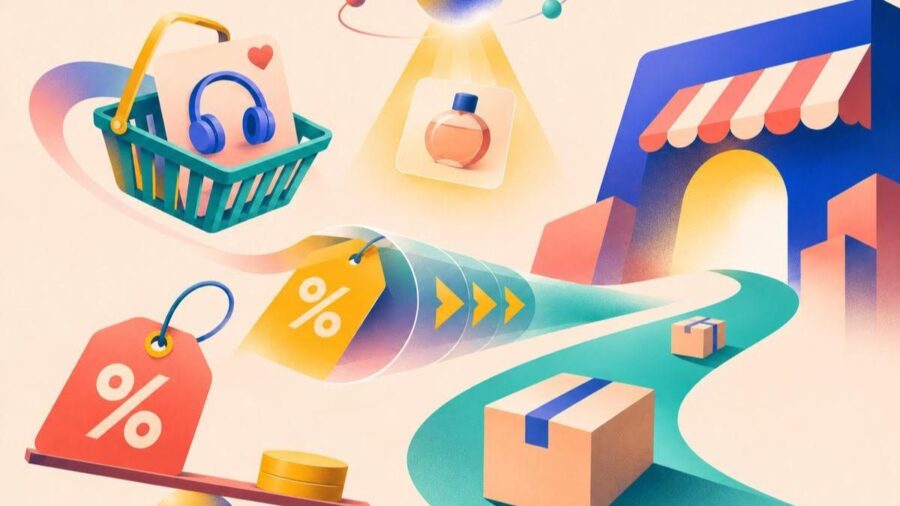
Some Black Friday shopping baskets are becoming watchlists. For shoppers holding out for a discount, an online basket can be a place to keep track of products while they wait.
Retailers are giving them plenty of opportunities. John Lewis began its Black Friday event on 17 November, promising to match prices at 25 competitors. Amazon’s European campaign runs from 19 to 30 November, with more than a million deals.
Germany’s retail association HDE forecasts €6.2bn in spending across Black Friday and Cyber Monday, nearly 6% more than last year. In Italy, Politecnico di Milano and Netcomm expect €4.3bn in online sales during Black Friday week, also up 6%.
Salesforce forecasts £28.9bn in UK online spending over November and December, up 1.5% on 2025.
The sales that came early
Longer promotions may be changing when shoppers buy, rather than how much they spend.
“Mostly pull-forward,” says Caila Schwartz, head of agentic commerce shopper insights at Salesforce. “Brands are shifting demand ahead of Cyber Week, as they do every year to ease pressure on Cyber Week volume and logistics. The bigger question this holiday season is margin.”
A KPMG survey of 3,000 UK adults found that 49% of those planning or considering Black Friday purchases had postponed buying items in the hope of securing discounts.
Emilie Benoit-Vernay, director of sales for Europe, the Middle East and Africa at Shopify, believes retailers should make better use of the entire shopping season.
“Black Friday is arguably the key moment in the wider holiday shopping period, though it’s no longer the only time consumers are buying,” she says. “Retailers need to maximise the opportunity across the whole season, not just one weekend.”
Benoit-Vernay recommends early access for loyal shoppers, targeted offers for customers comparing prices and clear delivery deadlines as Christmas approaches.
Shopify’s 2026 Holiday Retail Report found that shoppers said clear prices, product reviews and easy comparisons would make them more likely to use AI tools while shopping.
“Make it easy to add to cart, without forcing the purchase,” Benoit-Vernay says. Following up with customers need not always involve another price cut.
For retailers, the risk is offering discounts on purchases customers would have made anyway.
Competing on more than price
Amazon remains a formidable competitor. Research by brand-tracking firm Tracksuit found that 50% of surveyed UK Black Friday shoppers preferred the marketplace, compared with 8% for Argos.
In the survey, Amazon led on ease of use, range of deals and perceived delivery reliability. Among shoppers familiar with each retailer, 60% associated Marks & Spencer with trust, compared with 54% for John Lewis and 53% for Amazon.
“Smaller retailers don’t need to out-discount the biggest players to stand out,” says Benoit-Vernay. “Their advantage could come from what makes them different: a product you won’t find everywhere, specialist expertise, or a distinctive story about how and where it is made.”
Shopify’s research found that 47% of British businesses planned to highlight unusual or hard-to-find products, while 38% intended to emphasise their independent or small-business status.
Shoppers who begin their search on Amazon may never see those products.
Getting noticed beyond Amazon
Artificial intelligence could help smaller retailers reach those customers.
Salesforce predicts $357bn in global online sales during Cyber Week, from 24 to 30 November, with $75.8bn influenced by AI tools and shopping agents. This includes product discovery and recommendations, rather than purchases completed independently by agents.
Salesforce also reports that traffic to retailer websites from AI tools has risen 104% year on year, while visitors arriving through AI referrals are twice as likely to make a purchase as typical ecommerce shoppers.
Schwartz sees an opening for lesser-known retailers.
“With AI, shoppers are no longer limited to the biggest marketplaces,” she says. “In fact, 31% of consumers who have used AI to shop say it’s introduced them to new brands.”
But retailers need accurate product information to appear in those recommendations.
“For smaller businesses, AI gives them the opportunity to appear alongside major marketplaces,” Schwartz says, “but only if they have clear, well-structured product data and content to make them discoverable by both humans and AI agents.”
Chatbots are still a minority choice for UK shoppers looking for Black Friday deals. KPMG found that 12% of prospective UK Black Friday shoppers intended to use chatbots to find deals, down from 15% last year.
The delivery bill
Finding an attractive deal does not guarantee a purchase. DHL’s international Black Friday research found that one in three Black Friday shoppers said the delivery-options stage was where they were most likely to abandon a purchase.
Shipping also creates another expense for retailers already offering substantial discounts.
“With shipping costs higher in 2026,” Schwartz says, retailers are promoting collection from stores earlier in the season “to avoid delivery costs and bring shoppers into stores.”
Store collection may cut delivery costs, but customers still want convenient delivery and returns.
Salesforce forecasts record global online sales for Cyber Week. But retailers will need to look beyond Cyber Week’s takings to find out how much spending was genuinely additional, how much was brought forward from December and what remained after discounts, delivery costs and returns.
Some Black Friday shopping baskets are becoming watchlists. For shoppers holding out for a discount, an online basket can be a place to keep track of products while they wait.
Retailers are giving them plenty of opportunities. John Lewis began its Black Friday event on 17 November, promising to match prices at 25 competitors. Amazon's European campaign runs from 19 to 30 November, with more than a million deals.
Germany's retail association HDE forecasts €6.2bn in spending across Black Friday and Cyber Monday, nearly 6% more than last year. In Italy, Politecnico di Milano and Netcomm expect €4.3bn in online sales during Black Friday week, also up 6%.
