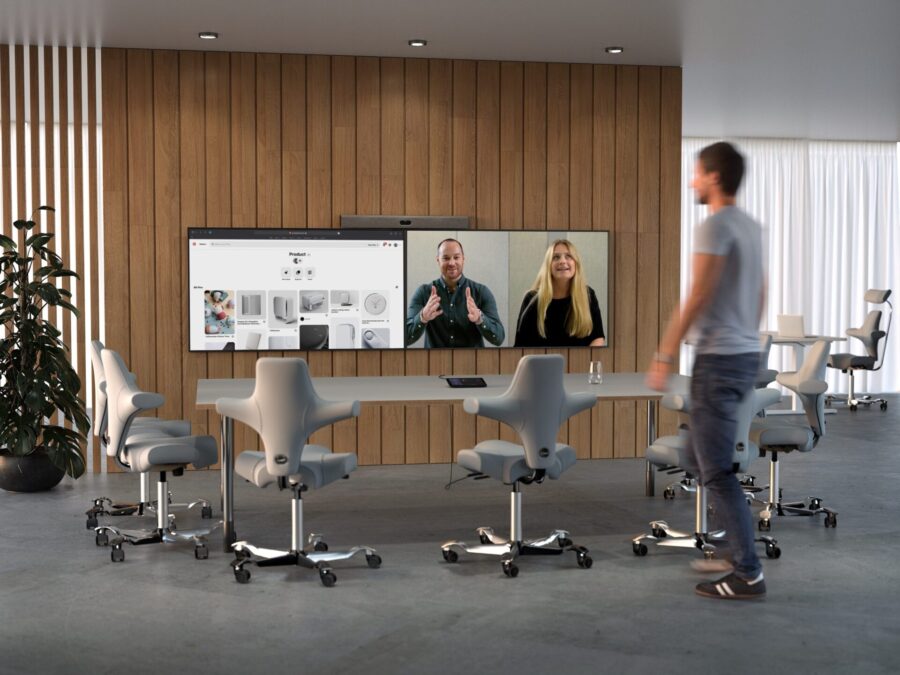
The demand for how we meet and collaborate has changed. Traditional meeting rooms, once seen as simple spaces for in-person discussions, are no longer sufficient. The room’s composition can shift hourly, changing from an all-in-person meeting to one dominated by remote attendees.
With employees splitting their time between home and the office, managers must rethink how meeting spaces bring remote and in-room participants together while ensuring everyone feels included and heard. To address this challenge, Neat’s Microsoft certified audio and video devices make virtual meetings feel closer to in-person interaction to bring the Teams experience into the physical meeting spaces. By improving audio, video, and room layout, it helps remote participants feel just as present as those in the room.
Why modern meeting rooms are falling short
Hybrid meetings often fall short for remote participants, particularly when room layouts fail to account for them.
“I remember a call with colleagues in the US where I was the only person joining remotely,” says Neat’s director of global technical sales, Graham Walsh. “Because of the room setup, all I saw was the back of their heads. I didn’t feel included in that meeting and almost felt like a stranger.”
For Walsh, this reflects a wider issue in hybrid work. He says it’s understandable that organisations still rely on pre-COVID meeting room designs and legacy devices to maximise existing investments, but argues these systems are out of touch with what people need.
“How we use meeting spaces has changed dramatically,” he says. “One hour, a room may be full of in-person attendees; the next, it may host a single person alongside 12 remote participants.” Meeting rooms therefore need to adapt to changing attendance patterns while delivering a consistent, inclusive experience.
The need for space
Many organisations are realising they need more meeting spaces, not fewer.
“People now come into the office to collaborate, whether that’s through whiteboarding, annotating or joining video meetings, and many organisations simply don’t have enough rooms to support this new way of working,” says Walsh.
He adds that meeting-room technology has become cheaper and easier to deploy, making it more practical for organisations to equip additional spaces while improving the overall video experience.
Neat Center companion device is designed to address the shortage of effective, hybrid-ready meeting rooms and make meetings more inclusive. Instead of showing remote participants a row of heads from behind, it captures the room from the centre of the table, looking outward. This creates a more natural perspective and helps everyone feel part of the same conversation, whether they are joining remotely or sitting in the room.
You can have the best cameras in the room, but that won’t help transcription if you don’t have really clear audio
Organisations can bring the familiar Microsoft Teams experience into meeting spaces and, where enabled, use Copilot capabilities such as transcription, summaries and recaps. Neat’s role is to ensure the room can clearly capture audio, video and meeting context, helping these AI-powered tools work as effectively as possible. By delivering high-quality capture across the room, Neat helps ensure conversations are recorded accurately, regardless of where participants are based.
“It’s like having your own personal note taker in the room,” says Walsh. Users can search meeting notes, turn key points into tasks and generate summaries of longer discussions. As Walsh puts it: “You can turn a one-hour meeting into a five- or ten-minute podcast-style recap.”
Microsoft is also developing video podcast-style summaries that capture key meeting moments as short-form clips, helping people catch up quickly on sessions they have missed.
While many organisations focus on video quality in remote meetings, Walsh argues that accurate transcription depends even more on audio. Clear microphone coverage across the room is essential if AI tools are to capture what is being said.
“You can have the best cameras in the room, but that won’t help transcription if you don’t have really clear audio,” he says. “You need to consider: can the softly spoken person sitting at the very back of the room be heard?”
To improve room-wide capture, Neat uses multiple microphones across its devices and controllers, helping deliver more accurate transcripts and AI-generated summaries.
Neat devices are also equipped with sensors, including people-count sensors that track room occupancy, and temperature and humidity sensors. Feeding this data into building management systems means organisations can make smarter and more informed decisions. For example, when rooms are empty, heating or air conditioning can be reduced to lower energy costs. Over time, this data can also be used to optimise space usage based on occupancy patterns, ensuring office space is used efficiently.
Reducing friction in the workplace
Neat is working with Microsoft to simplify deployment and enhance AI-driven collaboration in meeting rooms. According to Walsh, Microsoft Copilot can help manage room scheduling, automatically resolving conflicts and reducing friction for users.
Copilot can also start capturing notes as meetings begin, generate summaries and attribute comments to individual speakers. “It’s great having transcription notes, but the real value is knowing who actually said what,” says Walsh.
For Michel Bouman, EMEA, India & SEA AI-powered workplace lead at Microsoft, this addresses a longstanding challenge: “The meeting room is where decisions happen, but today most of that value walks out the door the moment people leave,” he says.
Agentic features in Microsoft Teams Rooms capture discussions, identify key actions and turn meetings into actionable outcomes. “In a world where 60% of work time is spent in meetings, AI in the room isn’t a luxury. It’s how you stop losing productivity at scale,” adds Bouman.
Neat also reduces barriers to adoption by mirroring the familiar Microsoft Teams desktop experience. Users can move seamlessly between their laptops and meeting spaces without learning new interfaces, making the technology easier to integrate into daily workflows. “The key thing is that training isn’t needed, because the meeting room experience looks just like the desktop client,” says Walsh.
Together, these developments are redefining the meeting room for the hybrid era. Rather than serving as a simple space for scheduled discussions, it is becoming an intelligent environment that captures knowledge, supports collaboration and helps organisations make better use of their time. The goal, says Walsh, is for the technology to fade into the background so people can focus on the conversation itself.
The demand for how we meet and collaborate has changed. Traditional meeting rooms, once seen as simple spaces for in-person discussions, are no longer sufficient. The room's composition can shift hourly, changing from an all-in-person meeting to one dominated by remote attendees.
With employees splitting their time between home and the office, managers must rethink how meeting spaces bring remote and in-room participants together while ensuring everyone feels included and heard. To address this challenge, Neat’s Microsoft certified audio and video devices make virtual meetings feel closer to in-person interaction to bring the Teams experience into the physical meeting spaces. By improving audio, video, and room layout, it helps remote participants feel just as present as those in the room.