
In 2026, businesses across waste management, recycling and construction industries will face increasing pressure to invest in onsite recycling technologies. This need for tech is being driven by a hike in landfill tax, tightening government regulations and pressure to source reliable and cost-effective secondary aggregates over quarried materials.
Government regulations are driving the adoption of onsite recycling tech
The landfill tax is an immediate issue facing leaders. The aim of the tax is to deter businesses from sending material to landfill and increase the incentive to recycle. In the UK, a standard rate of £126 per tonne is charged for general waste and a lower rate of £4.05 per tonne for inert materials (materials that aren’t environmentally harmful). But from April, the standard rate will increase to £130.75, with the lower to £8.65, eating into the margins of those who continue to dispose of waste at landfills.
Rob Symons, strategic projects director at CRJ Services, one of the largest waste management and recycling equipment suppliers in the UK and Ireland, says the tax hikes could get even worse. “The Environment Agency is finding quite a lot of material going to landfill under the lower tax bracket that should be in the higher tax bracket,” he says. “So, for the avoidance of doubt, they’ve been talking to the industry about one layer of tax in the future.”
The business case for onsite recycling
Government regulations are also driving the adoption of onsite recycling tech. New policies require utilities companies and new house building projects to use a significant percentage of recycled aggregates (crushed and processed materials recovered from construction and demolition waste), including at least 25% in new builds. But recycled and secondary aggregates already account for around 30% of Britain’s total construction aggregates, with demand rising sharply as projects seek secure, local, lower-carbon alternatives.
Industries that refuse to adapt could face a scarcity of resources. In 2024, the Minerals Products Association revealed that over the past decade only 61 tonnes of new permissions for sand and gravel have been granted for every 100 tonnes extracted. In the case of crushed rock, only 33 tonnes of new reserves were permitted for every 100 tonnes used. This means the stock of readily available raw materials needed for construction projects is fast running out in some areas.
It’s clear that leaders need to recycle more – and use tech to do so. But before they do, the starting point is education. Andrew Clarkson, managing director at CRJ Services, explains: “Most people think of waste as the black bag at the end of their driveway every week. They don’t think of aggregates as being waste. But what happens to the waste material when construction workers are digging up the motorways and relaying tracks on the railways? Where does it all go? All those aggregates need to be recycled.”
The real-world barriers to scaling wash plant adoption
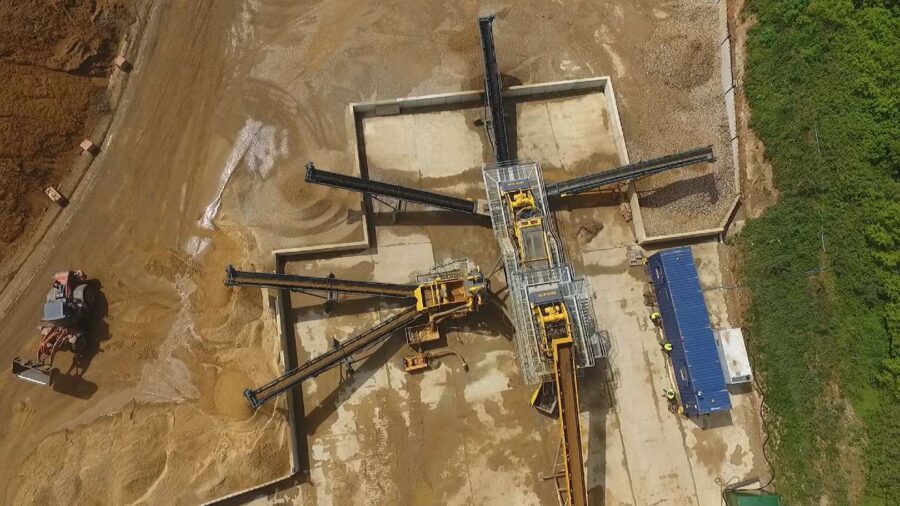
Many businesses are investing in onsite wash plants. Technology cleans and separates raw or recycled materials using water and screens, turning dirty mixed waste into high-quality usable construction-grade sand and aggregates. This means that businesses can reduce the amount of waste they send to landfill, costs spent on sourcing raw and recycled materials, lower their carbon footprint and be compliant with construction standards.
But investing in wash plants can be a lengthy and complex process. It also isn’t cheap, meaning businesses often turn to partners like CRJ Services to act as equipment providers and strategic partners to achieve their recycling ambitions. “It can cost £1-2 million for a plant that will process 50, 60, 70 tons an hour,” says Symons. “There are also a lot of bodies involved, such as the Environment Agency, to get planning permission. It’s a serious investment and so you must get it right.”
The next phase of onsite recycling will be shaped by intelligence as much as machinery
For CRJ, their role as a trusted knowledge partner often means saying no to a project if it’s clear that customers don’t have the infrastructure to justify the investment. “If you’ve not got good access to water, it’s a non-starter,” says Symons. “The water is the fuel to keep that wash plant going. To get a 60-tonne-an-hour plant started, you need 150 to 200 metres cube of water. To top that plant up during its day-to-day running, you’ll need another 15 metres cube per hour.”
It’s also a process that can take 18 months from conception to installing the wash plant at a recycling facility, quarry or construction site. Clarkson says that as government policies evolve, some businesses will need help in their efforts to invest in wash plants and other new technologies. “In some regions there is local help with funding, but that needs to be widespread across the UK,” he says. “There also needs to be an easing of regulations to remove barriers during planning permission, so businesses can move much faster.”
The shift toward intelligent, connected wash plants
But for those leaders that do decide to invest in wash plants, CRJ creates a bespoke solution specific to the needs of their individual businesses. In the future, this could involve incorporating new technologies to further enhance the efficiency and performance of wash plants and optimise sustainability efforts.
GPS, Google maps and other intelligent software is increasingly being used in wash plants as part of a wider shift toward smart, connected processing plants. GPS can be used to optimise site layout and material flow, reduce idle time and unnecessary movement, monitor supporting equipment such as loaders, excavators and dumpers and spot potential faults ahead of time.
“We install plants that have automated flocculant and sludge thickness monitoring,” says Symons. “This automatically records how long a wash plant is truly operating, idle or stopped, and can give accurate data for productivity, maintenance and compliance. It’s brilliant and it’ll make plants even more efficient.”
For leaders, the message is clear: smarter waste infrastructure is no longer a tactical upgrade, but a strategic investment. As access to virgin materials tightens, regulation accelerates and margins come under pressure, the ability to recycle efficiently, locally and at scale will increasingly define which organisations remain resilient and competitive.
The next phase of onsite recycling will be shaped by intelligence as much as machinery. Data-led decision-making, remote monitoring and more efficient use of water and materials will turn wash plants into connected performance-driven assets rather than standalone pieces of equipment. Those who act early – and invest with a clear understanding of operational realities – will be best placed to meet rising demand, reduce risk and build more sustainable construction supply chains for the years ahead.
In 2026, businesses across waste management, recycling and construction industries will face increasing pressure to invest in onsite recycling technologies. This need for tech is being driven by a hike in landfill tax, tightening government regulations and pressure to source reliable and cost-effective secondary aggregates over quarried materials.
Government regulations are driving the adoption of onsite recycling tech
The landfill tax is an immediate issue facing leaders. The aim of the tax is to deter businesses from sending material to landfill and increase the incentive to recycle. In the UK, a standard rate of £126 per tonne is charged for general waste and a lower rate of £4.05 per tonne for inert materials (materials that aren’t environmentally harmful). But from April, the standard rate will increase to £130.75, with the lower to £8.65, eating into the margins of those who continue to dispose of waste at landfills.