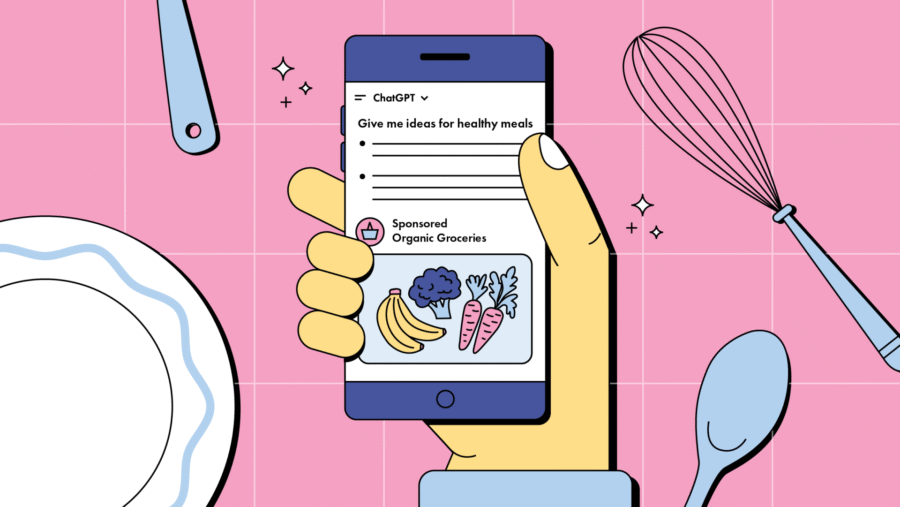
Its CEO may have once admitted to hating them, but OpenAI has begun rolling out ads on ChatGPT. First introduced to users in the United States in February, these ads are now entering pilots in Canada, Australia and New Zealand, with OpenAI affirming that it hopes “to expand to many more markets this year.”
The company claimed in its March update that the early results of its trials are “encouraging,” with no impact on how much ChatGPT users trust the LLM’s responses, and with a “low” dismissal rate for the banner ads they see at the bottom of chats. However, marketing professionals currently have mixed views on the power and utility of ChatGPT as an ad channel, with some telling Raconteur that it currently lacks the features of established platforms, and that it will have to scale up considerably to rival the likes of Google and Meta.
They also suggest that OpenAI’s success in this arena will depend on how it positions ChatGPT as an advertising platform, with the company already beginning a shift from a CPM (cost per thousand) to a CPC (cost per click) model. While such a move may help OpenAI generate more ad revenue in the near term, its mixture of paid and free tiers could end up limiting its growth, as could the possibility that ChatGPT users are less likely to click on ads.
Masses of potential, but not masses of performance data
As far as first impressions go, marketing experts have a largely middling opinion of ChatGPT’s ad offering, despite its potential for enormous reach, given the fact that the LLM attracts upwards of 700 million weekly active users. The main issue, at least at the moment, is that its ads platform lacks the wealth of performance data offered by incumbents, such as Google and Meta
“OpenAI’s ads manager currently lacks much of the functionality of established platforms, with limited visibility over performance though this is improving quickly,” says Claire Holubowskyj, a Senior Research Analyst at Enders Analysis, speaking to Raconteur.
Other experts agree, with Nicole Greene, a VP Analyst at Gartner, also telling Raconteur that ChatGPT doesn’t currently offer “more targeted advertising” than established platforms.
“It relies on conversation history and location but lacks the comprehensive demographic data, behavioural tracking, and audience segmentation offered by Google Ads and Meta,” says Greene.
There were other early weaknesses, including a comparatively prohibitive $250,000 minimum initial commitment, although in recent days OpenAI has reportedly lowered this to $50,000. Some other teething problems, however, appear to remain, although it may be reasonable to expect that OpenAI will deal with these over time, as it forms a clearer, fuller picture of which marketers are using its platform, and for what exactly.
“ChatGPT has enormous reach but low depth compared to established platforms”
Claire Holubowskyj, Senior Research Analyst at Enders Analysis
“Marketers also face limited buying control and predictability, with ads algorithmically inserted without traditional placement parameters or auction mechanics,” adds Greene. “Additionally, the platform suffers from immature measurement capabilities (lacking full-funnel reporting) and unpredictable brand safety risks due to the fluid nature of AI conversations.”
Because of this, Greene advises that brands that have complex content exclusions and suitability guidelines should use ChatGPT’s platform with caution. Such issues may disappear over time, yet analysts also note that the platform may face more insoluble problems, restrictions which may be inherent to how ChatGPTs subscriptions are structured.
As Claire Holubowskyj explains, “ChatGPT has enormous reach but low depth compared to established platforms: the heaviest users (which it would be able to target most effectively) will be on ad-free subscription tiers.” This could impose a significant block on growth, Holubowskyj suggests, since while ChatGPT will in time be able to target specific queries as or more effectively than search, it “will be less able” to target abstractly or generally, given the limited pool of heavy users on free or Go tiers (which currently see ads).
ChatGPT’s future place in the online marketing ecosystem
Despite these misgivings, there is widespread acknowledgement that ChatGPT presents a new and exciting medium for delivering ads, one that could be a hugely effective weapon in the arsenal of marketing departments. As Nicole Greene explains, its ad platform is “unique” in that it inserts banner ads directly into interactive dialogues, making it qualitatively different in form and context from legacy online marketing channels.
Dialogue-style creative formats allow brands to engage users in a less ‘salesy’ manner, which is particularly effective for high-information based purchase scenarios
“The platform excels in contextual relevance, serving ads based on immediate conversational flow and user intent rather than keyword bids,” she adds. “It encourages new, dialogue-style creative formats that allow brands to engage users in a less ‘salesy’ manner, which is particularly effective for high-information based purchase scenarios.”
If OpenAI can manage to seamlessly integrate advertising into the ChatGPT experience, rather than attempt to capture attention via intrusive messaging, then Greene suggests that its ads platform could end up being a success. Of course, it remains debatable as to how much of a success it will be, with Claire Holubowskyj predicting that marketers will mostly be using the platform as part of their wider multi-channel strategies.
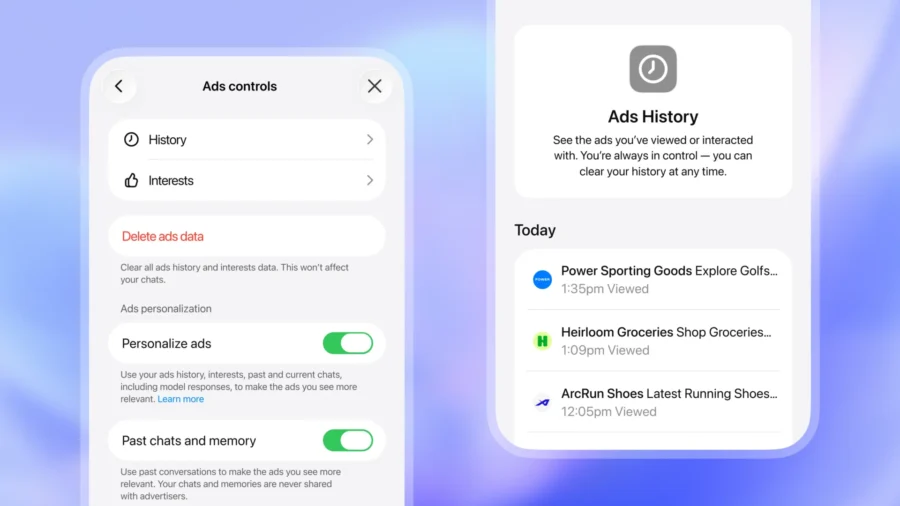
“How it fits into broader marketing strategies will depend on how ChatGPT positions itself,” she adds. And it may be a while yet before a clear and consistent position emerges, since OpenAI has already changed its approach in significant ways since launching ads, something which may be confusing to marketing departments, who could continue to take a wait and see approach.
“It initially positioned itself as an upper-funnel brand advertising alternative with a CPM offering, in line with their broader role as a discovery tool for consumers, but is now moving to CPC to assist advertisers who like to know what they’re paying for,” Holubowskyj says. “This sets itself up to compete further down the funnel with performance ads that are more data-driven, eroding its own differentiation.”
After launching with a cost-per-thousand model (now at a price of between $25 and $45 per thousand), OpenAI has recently introduced cost-per-click ads. These are currently at a price of between $3 and $5 per click, and while they do make ChatGPT’s ads platform more attractive to advertisers who want to confirm the bang they’re getting for their buck, their quick introduction does add to the perception that the platform remains very much within an experimental phase.
How brands and marketers will need to change their ad strategies
For this reason, Nicole Greene confirms that Gartner is currently advising its clients to treat ChatGPT as “a supplementary ‘test-and-learn’ channel,” as opposed to a potential replacement for core platforms. She says, “Google’s global ad spend dominance leverages vast end-user data and benefits from organic distribution across platforms like YouTube,” whereas “feedback is mixed across industries” for ChatGPT’s ads platform in its current form.
“It’s not only about the first message, it’s about the next right message to deliver with the-end to-end customer journey being contained and accelerated within the ChatGPT platform.”
Nicole Greene, VP Analyst at Gartner
That said, Greene also argues that the platform could make lots of sense for companies operating in “high-consideration, information-rich categories,” where conversational AI may inform and sway purchase decisions. Yet this would, she suggests, require advertisers to create content in new ways, moving from static messages and investing in natural-language scripts and interactive prompts that can fit seamlessly into user conversations. “It’s not only about the first message, it’s about the next right message to deliver with the-end to-end customer journey being contained and accelerated within the ChatGPT platform,” she says.
To accompany and facilitate such changes, measurement on ChatGPTs platform will need to shift from a focus on standard click-through rates to also include data on conversational metrics, such as dialogue engagement and follow-up questions. Meanwhile, Greene emphasises that brands will need to develop their AEO (answer engine optimisation) strategies, which require evolution beyond a traditional SEO approach. She explains, “This requires changes in content creation and structuring product data — such as titles, SKUs, pricing, and availability — so that it is optimised for AI interpretation rather than human keyword searches.”
Carving out ‘a highly profitable niche’
Such developments will take time to materialise, and even when ChatGPT’s ad platform stabilises, marketing experts are still unsure whether it will ultimately rival Google, Meta or any other major player. And as noted above, rivalling such platforms will require OpenAI to fix the current weaknesses of ChatGPT’s ads manager.
“It is still an unproven format, and lots of early interest will stem from curiosity, but this won’t last long without results,” says Holubowskyj. “OpenAI still needs to join up the dots between its user data and its ad manager to be able to offer enough inventory to satisfy early demand.”
Holubowskyj also notes that Google itself is already a significant competitor for ChatGPT in the ads department, with its AI Overviews producing over 600 million AI-generated summaries every day. Not only does this suggest that OpenAI has its work cut out, but data on how people are less likely to click on links if they see AI summaries would suggest that conversational AI may not be the best conduit for advertisements.
This worry aside, analysts are optimistic that ChatGPT’s ads platform could perform well in the more distant future, once it has responded to feedback and made necessary improvements. “In the long term, if OpenAI enhances its measurement tools and buying controls, the platform could carve out a highly profitable niche in information-rich, high-consideration categories,” agrees Greene.
Its CEO may have once admitted to hating them, but OpenAI has begun rolling out ads on ChatGPT. First introduced to users in the United States in February, these ads are now entering pilots in Canada, Australia and New Zealand, with OpenAI affirming that it hopes “to expand to many more markets this year.”
The company claimed in its March update that the early results of its trials are “encouraging,” with no impact on how much ChatGPT users trust the LLM’s responses, and with a “low” dismissal rate for the banner ads they see at the bottom of chats. However, marketing professionals currently have mixed views on the power and utility of ChatGPT as an ad channel, with some telling Raconteur that it currently lacks the features of established platforms, and that it will have to scale up considerably to rival the likes of Google and Meta.
They also suggest that OpenAI’s success in this arena will depend on how it positions ChatGPT as an advertising platform, with the company already beginning a shift from a CPM (cost per thousand) to a CPC (cost per click) model. While such a move may help OpenAI generate more ad revenue in the near term, its mixture of paid and free tiers could end up limiting its growth, as could the possibility that ChatGPT users are less likely to click on ads.