01
Collaboration, capability, AI and the road to 2030
What comes next: how GenAI is reshaping the legal market
Sponsored by

Commercial Feature
Collaboration, capability, AI and the road to 2030
As generative AI adoption accelerates across the legal sector, law firms and in-house teams are being forced to rethink how legal work is delivered, where human expertise adds value and how collaboration will shape the future legal market
Christine Horton

In association with

Christine Horton
In association with
The legal industry is entering what could be its most significant period of transformation in decades.
As generative AI (gen AI) moves from experimentation into everyday workflows, both law firms and in-house legal teams are being forced to rethink how legal work is delivered, how value is measured and where human expertise fits into increasingly AI-enabled operations.
According to Thomson Reuters Institute’s 2026 AI in Professional Services Report, AI adoption across the legal sector has doubled over the past year, while half of organisations expect agentic AI to become central to legal workflows within two years.
For many organisations, the challenge isn’t whether AI will shape the future of legal services, but how quickly they can adapt to it.
Speaking at the company’s recent Legal Innovation Summit, Lizzy Duffy, senior director at the Thomson Reuters Institute, said the pace of change is already accelerating across the legal ecosystem.
“We know there’s a transformation taking place across the legal ecosystem as the pace of AI evolution accelerates. Legal professionals who support, protect and enable business must change too,” she said.
Moving beyond experimentation
According to Duffy, the legal market has already moved beyond the early phase of AI pilots and experimentation into real deployment.
Yet despite growing adoption, uncertainty remains around how AI is being used in practice. Duffy pointed to research showing that many corporate legal teams are still unclear about how their external firms are deploying AI within client work.
At the same time, clients themselves are increasingly driving the pace of change.
“We’re seeing that it is the client side that’s setting the pace. Our latest report into AI adoption in professional services shows that two-thirds of clients are optimistic about AI, compared with just around a half of law firms,” said Duffy.
That shift is putting pressure on firms to modernise both their technology strategies and their operating models. The Thomson Reuters Institute’s research indicates that legal expertise alone is no longer enough, as clients increasingly expect firms to combine technical capability with AI-enabled service delivery and greater efficiency.
Why collaboration matters
As AI reshapes legal workflows and client expectations, the interdependence between law firms and in-house legal teams is becoming increasingly important. Despite that, Duffy warned that many organisations are still approaching transformation separately rather than collaboratively.
“At this moment, both sides – law firms and the legal departments – are retreating into their own silos to build the future separately at just the moment when they really should be coming together,” she said.
A major focus for Thomson Reuters itself is understanding what the future legal department could look like by 2030. Through an internal initiative known as GCO 2030, the company’s legal team, in partnership with the Thomson Reuters Institute, is exploring how AI, automation and new workflows could reshape legal operations over the next five years.
Duffy outlined five emerging “archetypes” that she believes will define the modern legal department, ranging from large-scale automation of repetitive work through to deeper collaboration between legal teams and functions such as HR, finance and sales.
At the centre of all of them, she said, is a “tech-forward mindset” where legal professionals consider the right balance between human expertise and technology to achieve the best business outcome.
One of the biggest changes could come in how legal departments engage external firms. Duffy said AI is pushing organisations to become far more strategic about the work they outsource.
“Our goal is not to eliminate the need for law firms, but it is to work with them more strategically and more efficiently. We don’t want to pay for the same legal advice twice,” she said.
Redefining the legal market
The changes underway are expected to reduce demand for some forms of routine legal work, while increasing demand for high-value advisory services, specialist expertise and complex disputes.
Duffy outlined several possible futures for law firms, including “tech-led disruptors” built around AI-driven delivery models, “elite boutiques” focused on premium specialist expertise, and “integrated powerhouses” combining scale, standardisation and AI-enabled client services.
Crucially, Felix Steffek, professor of law at the University of Cambridge and principal legal AI advisor at Thomson Reuters, argued that AI’s ability to reduce legal transaction costs could fundamentally expand the market for legal services rather than shrink it.
“Legal AI reduces transaction costs and creates agency to shape the future,” he said.
Steffek also argued that AI systems are beginning to capture value traditionally created through routine legal work, particularly tasks previously handled by junior lawyers.
For legal leaders, the challenge now is determining where their organisations fit into this changing value chain. Duffy believes collaboration will ultimately determine which organisations thrive.
“None of these questions can be solved by one group alone,” she said. “By coming together to answer these questions, law firms and legal departments can help to shape a future for the legal market that is resilient, transparent and sustainable.”
Watch the key talks from Thomson Reuters’ ‘Legal Innovation Summit’ on-demand below
Q&A: How AI is transforming legal workflows
Built on trusted legal content and designed for real-world legal workflows, Thomson Reuters’s CoCounsel Legal is helping firms and in-house teams rethink how legal work is researched, reviewed and delivered in an increasingly AI-enabled industry.

Thomson Reuters’s CoCounsel Legal is designed to bring generative AI directly into legal workflows, combining large language models with trusted legal content from sources including Westlaw and Practical Law. The platform helps legal teams research, review and draft documents while maintaining the verification and auditability required in legal work.
Rawia Ashraf, head of product for CoCounsel transactional and GCO, explains how the platform is evolving and where AI could reshape legal services next.
Q
What problem is CoCounsel Legal designed to solve in today’s legal workflows, and where did you see the biggest gap in existing tools?
A
The biggest challenge is ensuring AI delivers authoritative and verifiable answers. Generative AI can improve legal work, but lawyers need outputs they can trust and audit.
We also saw a gap around legal specialisation. Legal workflows are nuanced, so we focused on grounding CoCounsel in trusted legal content rather than building a generic AI tool.
Q
What are the key capabilities of CoCounsel Legal that clearly demonstrate its impact for legal professionals? Which workflows are seeing the quickest uptake?
A
Legal research and document review are seeing the strongest adoption. Lawyers are using CoCounsel to analyse contracts, support negotiations and carry out due diligence more efficiently.
One area growing quickly is tabular analysis, which allows teams to review large volumes of documents and extract key information through natural language prompts rather than manual review.
Q
How does CoCounsel balance general-purpose AI with specialised legal intelligence?
A
We use an agentic framework that allows CoCounsel to reason through tasks using trusted resources such as Westlaw and Practical Law. The system is continuously tested by our in-house legal experts to improve performance and accuracy. That combination of authoritative content, legal expertise and validation is critical.
Q
How can legal teams use CoCounsel Legal in a live transaction – from start to finish?
A
A legal team could upload a policy or contract, ask CoCounsel to assess risk, recommend a strategy and produce a revised version of the document. The platform can review material, research legal frameworks, identify risks and draft amendments within the same workflow, while linking back to sources throughout.
Q
What major evolution do you see in how legal teams will interact with AI over the next few years?
A
So far, most organisations have focused on using AI to speed up existing tasks. The next phase will be about redesigning workflows altogether.
Legal teams will increasingly look at which steps can be delegated or restructured through AI, rather than simply speeding up existing processes.
Q
Are you seeing AI reshape who does what within legal teams?
A
The judgement still belongs to the lawyer. CoCounsel can accelerate work and surface information quickly, but lawyers remain responsible for applying legal judgement and making decisions.
AI changes the scale and speed at which legal teams can work.
Q
What new skills will legal professionals need to develop to get the most out of tools like CoCounsel Legal?
A
Judgement will remain the most important skill. Lawyers will also need curiosity and openness to experimentation.
Q
What does success look like in terms of adoption and real-world impact of CoCounsel Legal?
A
Success means legal teams having a reliable AI partner that helps uncover risks and make better use of institutional knowledge.
The real opportunity is enabling lawyers to focus more time on strategic work rather than repetitive tasks.
Q
What comes next for CoCounsel?
A
We’re continuing to expand the next generation of CoCounsel Legal across global markets, including the UK and Europe, while investing further in trusted content, workflow integration and agentic AI capabilities.
5 steps to turn AI hype into measurable results
Legal leaders are increasingly shifting the AI conversation away from hype and towards measurable business outcomes, with firms now focusing on governance, workflow redesign and proving long-term value from AI investments.
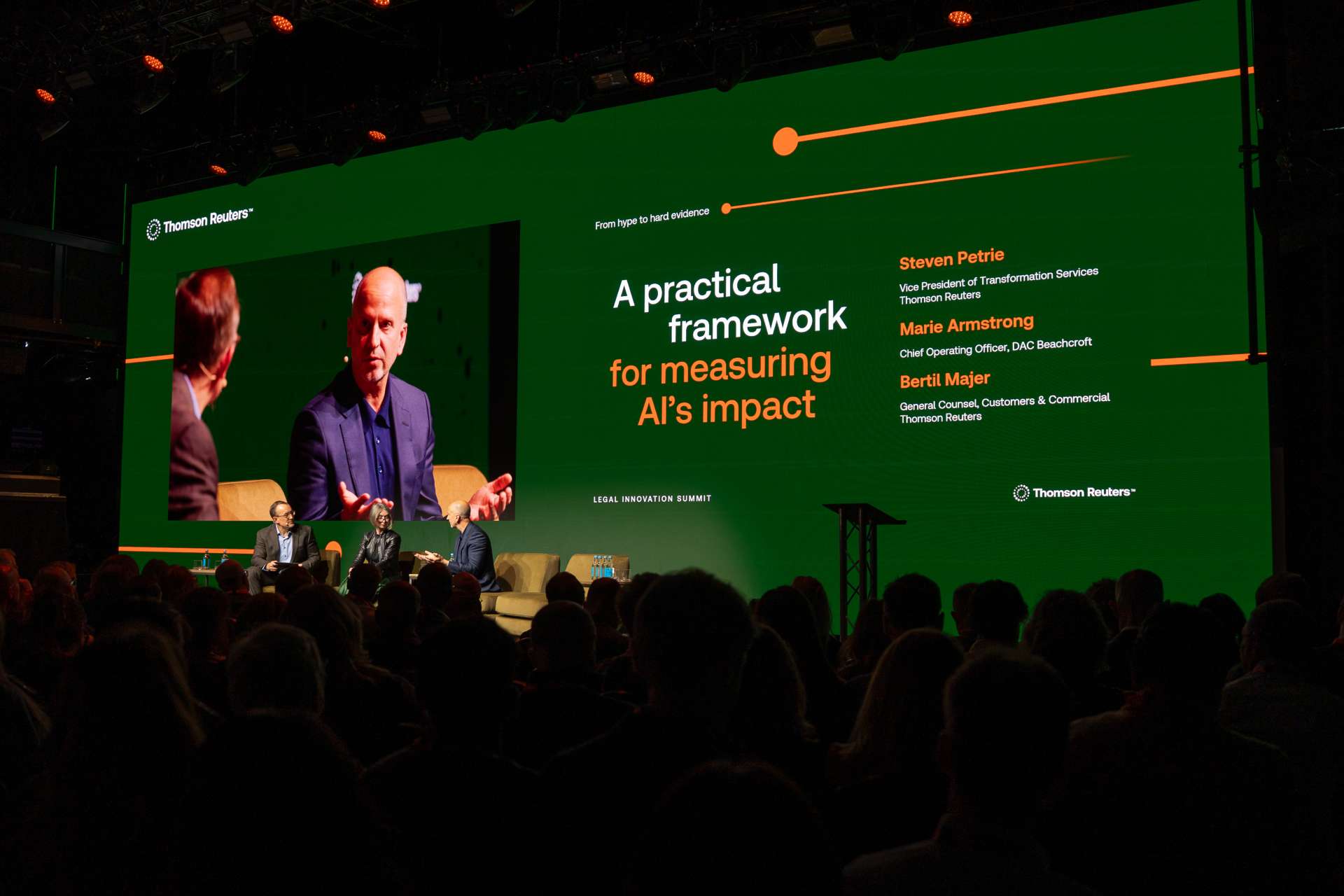
Legal AI conversations are moving into a new phase. After two years dominated by experimentation, pilots and proof-of-concept projects, legal leaders are now being asked a tougher question: what measurable value is AI really delivering?
Pressure to demonstrate value from AI investments is growing across both law firms and in-house legal teams, particularly as clients demand greater transparency around how the tech is being used and whether it’s improving efficiency, quality and service delivery.
It was a topic under the spotlight during Thomson Reuters’s Legal Innovation Summit, where legal and innovation leaders shared how to move beyond AI enthusiasm and build meaningful frameworks for measuring impact.
01
Start with the workflow, not the technology
According to Bertil Majer, general counsel, customers and commercial at Thomson Reuters, measuring AI ROI starts with identifying a specific workflow and establishing a baseline before introducing new tools.
“You basically pick the workflow, baseline it, and then define what the return really is. Is it quality, is it time, is it risk or is it cost?”
Majer argued that organisations often leap too quickly to cost savings as the primary success metric, despite other benefits potentially delivering greater long-term value.
“Everybody jumps at the cost, but from the in-house perspective, actually quality would be my primary objective,” he said.
The key, he suggested, is choosing a clearly defined process where improvements can be measured realistically. Thomson Reuters itself began with non-disclosure agreement workflows because they were repetitive, measurable and high volume.
02
Measure more than cost savings
One of the biggest challenges for legal leaders is proving AI value beyond simple financial metrics.
Speakers argued that while leadership teams often focus on hard KPIs such as time savings and operational costs, legal organisations also need to measure improvements in quality, turnaround times, consistency and client experience.
That becomes particularly important in legal environments where AI may allow lawyers to focus more time on strategic work rather than repetitive admin tasks.
Steven Petrie, VP of transformation services at Thomson Reuters, noted that AI requires a broader approach to measurement than many organisations are used to.
“A multifaceted capability like AI requires a multifaceted measurement approach,” he said.
03
Build governance and change management into every AI project
The experts warned that many AI initiatives fail because organisations focus too heavily on the technology itself rather than the supporting structures around it.
Speakers stressed the importance of establishing governance frameworks, product ownership and change management processes before scaling deployment. That includes identifying AI champions within the business, creating opportunities for teams to share best practices, and ensuring experimentation happens within clearly defined guardrails.
The discussion also highlighted the growing challenge of “shadow AI”, where employees independently adopt unauthorised tools outside official governance processes. Majer warned that organisations eventually need to move beyond fragmented experimentation and converge around trusted approaches and platforms.
04
Align AI measurement with changing client expectations
Clients are increasingly scrutinising how law firms are using AI and whether those investments are translating into measurable improvements.
The panel noted that requests for proposals now regularly include detailed questions around AI governance, innovation strategies and operational efficiency, reflecting growing client expectations around transparency and value.
That’s forcing firms to rethink pricing models and service delivery. As routine work becomes increasingly automated, firms are under pressure to demonstrate where human expertise still creates strategic value.
Majer argued that legal work is effectively moving “up market”, with in-house teams taking on more internally while external firms focus increasingly on highly specialised or complex matters.
05
Treat AI transformation as a long-term operational shift
The panel repeatedly warned against chasing “shiny new tools” without clear business objectives or sustainable operating models behind them. Instead, leaders argued that firms should focus on building repeatable processes, reliable outputs and organisation-wide adoption strategies.
“We have to move beyond perpetual experimentation,” said Petrie.
Elsewhere, the discussion highlighted how AI is reshaping legal talent models. Routine junior work is increasingly being automated, while lawyers are expected to develop new skills around process design, AI-enabled delivery and working alongside emerging technologies.
Majer suggested organisations should avoid viewing AI skills too narrowly, arguing that the pace of technological change means today’s specialist skills may evolve rapidly over the next few years.
For legal leaders, measuring AI impact is no longer optional. As AI becomes embedded into legal workflows, firms and legal departments will increasingly be judged not by whether they are experimenting with AI, but by whether they can demonstrate meaningful, measurable outcomes from it.
Scaling AI experimentation to enterprise impact
Scaling AI across legal operations requires far more than deploying new technology, with leaders increasingly recognising that governance, change management and employee adoption are just as critical as the AI tools themselves.

For many legal organisations, the biggest challenge with AI is no longer getting started – it’s scaling successfully.
Across both law firms and in-house legal teams, experimentation with gen AI has accelerated rapidly over the past two years. But moving from isolated pilots to enterprise-wide adoption remains significantly harder, particularly in highly regulated environments where governance, risk management and client expectations all need to evolve alongside the technology.
So what does it actually take to scale AI beyond experimentation and turn it into sustained business value?
For Agustin Sanchez, director of customer success at Thomson Reuters, successful AI transformation starts long before technology is deployed.
“It starts with mindset,” he explained.
According to Sanchez, organisations that scale AI successfully combine curiosity and experimentation with leadership sponsorship, accountability and structured change management.
“If that mindset is the right one, then accountability comes into shape, then the right processes and structures are in place,” he said.
Beyond the pilot phase
Nevertheless, many organisations remain stuck between early experimentation and true operational transformation. While many businesses have introduced AI tools into parts of their legal operations, far fewer have embedded them deeply enough into workflows to create measurable enterprise-wide impact.
For Sanchez, the difference between being successful and being at a standstill often comes down to whether organisations treat AI as a standalone tech project or as a broader operational transformation programme. That involves identifying practical use cases early, establishing leadership buy-in and ensuring teams understand why AI is being introduced in the first place.
“What are the areas where we think AI has the largest potential for change and for return on investment?” Sanchez said.
He argued that well-defined use cases create momentum internally and help organisations build confidence in AI deployment before scaling further.
Embedding AI into legal workflows
Within the legal industry workflow-integrated AI tools that can operate within existing legal processes rather than forcing teams to work separately from them are gaining prominence.
Sean Edwards, head of legal, corporate finance and asset lending at Sumitomo Mitsui Banking Corporation, said his organisation had recently implemented CoCounsel as part of a wider AI strategy across the bank. He believes one of the major opportunities AI creates is the ability to work more effectively with large volumes of legal and operational data across the organisation.
“Lawyers are very good at marshalling data,” he said.
But he also stressed that scaling AI in regulated industries requires strong governance structures from the outset, particularly around security, confidentiality and internal approvals.
“It’s irritating to have to go through these approval processes,” he said. “But having that infrastructure is really important.”
Of course, trusted AI systems must be able to operate safely within highly regulated environments while maintaining explainability and governance controls. That becomes particularly important as organisations look to connect AI across broader enterprise workflows rather than limiting it to isolated legal use cases.
Why adoption matters as much as technology
Scaling AI successfully depends as much on adoption and enablement as it does on the technology itself.
Here, Tina Lepomme, Senior Legal Technologist at Addleshaw Goddard, argued that organisations need to give employees space to experiment with AI directly rather than simply mandating adoption from leadership teams.
“If the leadership gives the space and incentivises the use of AI, combined with giving everyone within the organisation the time and access to the tools to see what they can do, then you get those lightbulb moments,” she said.
When it comes to scaling AI, the experts advocate for a staged process rather than a single deployment event.
According to Sanchez, the first month is typically focused on broad adoption and familiarisation, while later stages focus on embedding AI into everyday workflows and eventually redesigning operating models entirely.
“At the six-month milestone, that’s when the magic happens. That’s when things have changed,” he said.
By the 12-month stage, he argued, organisations begin to see structural changes around staffing models, workflows and how work itself is delivered.
Turning experimentation into enterprise value
Organisations cannot afford to treat AI as a temporary innovation project. Scaling AI requires long-term operational commitment, clear governance and continuous iteration as both technology and user expectations evolve.
Edwards warned that organisations also need realistic expectations around ROI, particularly during the early stages of deployment.
“There’s a bit of real education there,” he said.
While some cost reductions may eventually emerge through lower external legal spend or improved efficiency, the legal and tech leaders argued that many of the most valuable gains initially come through improved capacity, faster workflows, better access to information and stronger collaboration across teams.
For Sanchez, the key is ensuring organisations remain ambitious while continuing to scale responsibly.
“Be ambitious, be bold,” he said.
As legal teams continue moving beyond experimentation, the organisations that succeed are likely to be the ones that combine AI innovation with operational discipline – embedding trusted, workflow-driven AI directly into how legal work gets done.