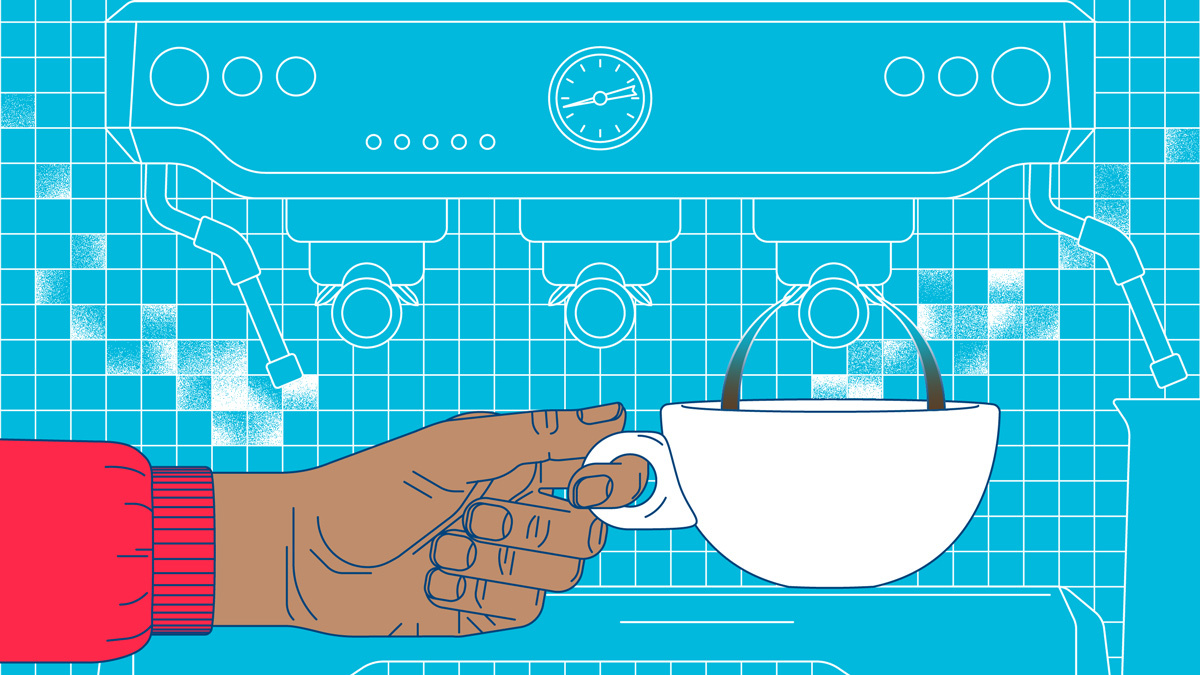
A barista’s palate cannot be automated. Yet rising costs across coffee production and higher expectations from the drinking public make precision and efficiency financial imperatives. And these influencers are beginning to change even the most specialist of areas: today, instead of a barista testing every grind and pressure combination by hand, it’s perfectly achievable to have an automated systems handle calibration in real time.Mahlkönig’s Sync System, for example, links espresso machines directly to connected grinders, altering burr settings automatically when a shot runs too fast.
The push to automate stems from financial necessity. Arabica futures topped $3/lb in August, while weak consumer confidence hangs over the high street. World Coffee Portal l values the UK branded coffee-shop market at £6.8bn across 12,313 outlets, but only 37% of operators report positive trading conditions. Foodservice analyst Peter Backman says employer National Insurance changes and National Living Wage increases hit businesses reliant on part-time staff hardest. Labour, he warns, risks becoming “a structural cost operators have to design their business around”.
Automating the work behind the cup
Mahlkönig’s system removes calibration work while keeping the recipe under human control. The machine can protect consistency, but it cannot decide whether that recipe still tastes right as beans age or conditions change.
Dale Harris, founder of Birmingham roastery and café Ithaka Coffee and 2017 World Barista Champion, sees the clearest case for automation in repetitive tasks. “Almost anything that’s a repeated, mechanical act, but doesn’t require thinking or emotional intelligence” can be automated, he says.
Costa Coffee has automated work beyond espresso preparation. Its work with Vega IT replaced more than 20 manually maintained spreadsheets with a centralised pricing and menu system. Vega says the project cut manual workload by more than 90% and automated nutrition and allergen calculations.
Costa Express machines can report faults, monitor performance and track consumption remotely, helping operators diagnose problems before sending an engineer.
Automate the friction
World Coffee Portal research found only 17% of UK consumers agreed that coffee from an automated machine could rival a barista-made drink, while 63% disagreed.
Backman says the strongest case for automation is where demand has predictable peaks and customers are not primarily paying for barista skill, such as transport hubs, hospitals and forecourts. It can be stronger still in bakeries and convenience stores, where automation can create coffee sales without requiring a trained barista.
Operators should also be wary of treating automation simply as a way to reduce staffing. “Productivity is output per hour, not cost per hour,” Backman says. At peak times, the constraint is often how quickly customers can be served, making throughput more important than reducing headcount.
One model removes the barista altogether. JD.com’s 7Fresh Coffee opened a 24-hour robotic shop in Beijing in August capable of grinding, extracting, mixing and dispensing drinks without one.
But that model solves a different problem from a neighbourhood speciality café. For Harris, the dividing line is hospitality. “In the best cafés, baristas are able to share that connection with great hospitality, coffee knowledge, and the ability to understand a customer and give them the experience they’re looking for, and no automation can replace that.”
On the high street, automation looks most useful when it takes repetitive work off the barista without taking the barista out of the experience.
A barista’s palate cannot be automated. Yet rising costs across coffee production and higher expectations from the drinking public make precision and efficiency financial imperatives. And these influencers are beginning to change even the most specialist of areas: today, instead of a barista testing every grind and pressure combination by hand, it's perfectly achievable to have an automated systems handle calibration in real time.Mahlkönig’s Sync System, for example, links espresso machines directly to connected grinders, altering burr settings automatically when a shot runs too fast.
The push to automate stems from financial necessity. Arabica futures topped $3/lb in August, while weak consumer confidence hangs over the high street. World Coffee Portal l values the UK branded coffee-shop market at £6.8bn across 12,313 outlets, but only 37% of operators report positive trading conditions. Foodservice analyst Peter Backman says employer National Insurance changes and National Living Wage increases hit businesses reliant on part-time staff hardest. Labour, he warns, risks becoming “a structural cost operators have to design their business around”.