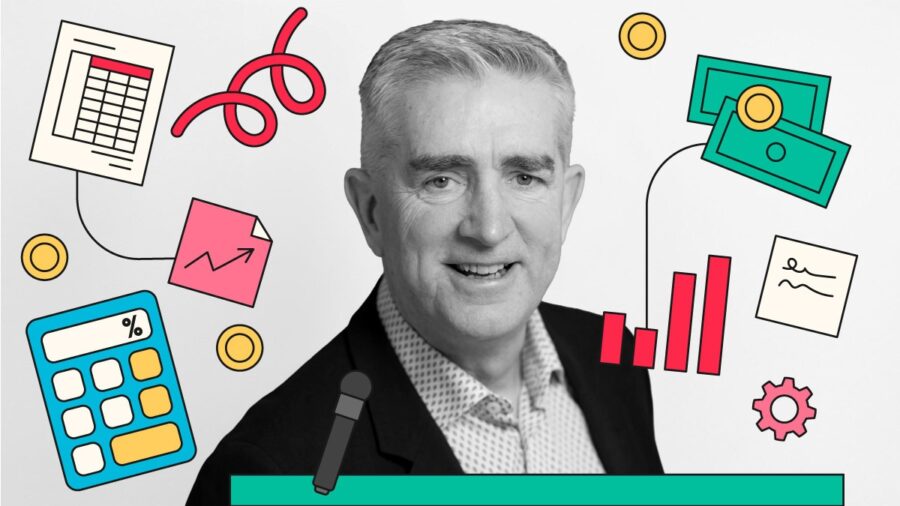
Niall O’Sullivan is CFO at Aryza, where he works on bringing together a growing group of acquired businesses into a more connected organisation.
With a career spanning more than three decades, O’Sullivan has held senior finance roles across global technology companies including Oracle, Dell, Vodafone and Google. His experience has taken him across the UK, Ireland and Portugal, working with teams operating in different markets, cultures and stages of growth.
Today, O’Sullivan’s focus is on helping companies modernise their finance functions, improve decision-making and build the foundations needed to support long term growth.
How did you become a CFO?
My career has had many twists and turns. I qualified as an accountant with KPMG in Dublin after completing a law degree, and moved fairly quickly into senior roles within technology companies. I was one of the first employees setting up Oracle in Ireland and later worked at Dell, where I helped establish early cross-border call centres using new telecoms technology. That experience sparked a long-term interest in how technology could reshape finance and operations.
From there, I became CFO during the early days of the mobile phone industry in Ireland, working on business cases for technology that had not yet fully materialised. My career then took me through multinational roles across Portugal and the UK, managing teams across different systems and cultures, before shifting into large scale finance transformation work. Over time, that experience led me into private equity-backed businesses, where I could apply those transformation skills in faster growing environments, ultimately leading to my current role.
What skills or traits does a good finance leader need?
You need to be able to see patterns in numbers and understand what is really happening behind them. Saying results are up one hundred percent doesn’t tell the full story unless you can explain why.
A finance leader also has to tell the story behind the numbers. Too much data and too many reports overwhelm people, so it’s important to translate what matters and explain it clearly to non finance teams.
Finally, integrity is critical. A CFO has to be the voice of reason in the business, especially when there is pressure to hit targets or forecasts. Being honest about what the numbers are really saying is a core part of the role.
What excites you most about your current role?
Everything is changing at the moment. We are a fast growing business and have acquired several companies in a short space of time. What started as a relatively small Irish company is now building international operations.
What excites me is helping put the foundations in place so the company can scale properly. That means building systems, processes, and reporting that allow the business to grow while still giving leadership the information they need to make decisions.
What’s the biggest challenge facing your sector at the moment?
The biggest challenge is balancing demand with constant change. You’re trying to build something new, but the day to day demands never stop. It is like changing the wheels on a car while it’s still moving.
Finance is increasingly at the centre of everything, especially with private equity involvement and higher expectations from investors. The demand for fast, accurate information keeps growing, but there is often little understanding of how difficult it is to deliver that while transforming systems at the same time.
What single thing would make the job of CFOs in smaller companies easier?
Access to experienced, independent mentoring. When I worked in very large organisations, there were always people you could talk to who had done something similar before.
In smaller companies, you do not always have that support. There are plenty of people willing to sell you software or services, but very few people you can speak to openly who have deep experience in finance transformation and can help you think through decisions without an agenda.
What is the best bit of business advice you’ve ever received?
If you see something wrong in the numbers, put your hand up as soon as you notice it. You build trust in your investors and colleagues by identifying issues quickly and then taking control of the issue.
I have seen people try to hope that the situation will resolve itself. That never works. People trust you more when you own up to your own or your team’s mistakes quickly and deal with them openly. Even if there is a short-term reaction, your reputation is far better protected in the long run, as it is the most important attribute you need for building a career.
Which book do you think every finance leader should read at least once?
Books that explore what goes wrong when people in finance fail to speak up. Liar’s Poker and The Smartest Guys in the Room, both by Michael Lewis, are good examples.
They show what happens when finance stops being the guardian and starts trying to be a cheerleader. A lot of the lessons from the financial crisis were about human behaviour, not technical accounting, and those lessons are still relevant.
What do you do outside of work to protect yourself from burnout?
I play a lot of golf, and it’s a big part of life in Ireland. My club has a very active competition scene, and it’s something I really enjoy because it gives me time away from the desk and a chance to switch off.
Sport more broadly plays a big role here as well. Whether it’s rugby, football, or Gaelic sports, being active gives people a way to step away from work, reset, and come back with a clearer head.
What’s been your proudest achievement in your current role?
I’m proud to see people who used to work for me go on to become CFOs themselves. Watching people develop and move into more senior roles is incredibly rewarding. Earlier in my career, I also take pride in the long-term impact of the finance transformation work I led, especially seeing systems and teams evolve into stronger, more effective operations over time.
If you weren’t a CFO, what would you like to do?
When I was younger, I wanted to be a footballer. One former colleague of mine ended up managing Chelsea Football Club, which always struck me as a pretty good alternative career.
Niall O’Sullivan is CFO at Aryza, where he works on bringing together a growing group of acquired businesses into a more connected organisation.
With a career spanning more than three decades, O’Sullivan has held senior finance roles across global technology companies including Oracle, Dell, Vodafone and Google. His experience has taken him across the UK, Ireland and Portugal, working with teams operating in different markets, cultures and stages of growth.
Today, O’Sullivan's focus is on helping companies modernise their finance functions, improve decision-making and build the foundations needed to support long term growth.