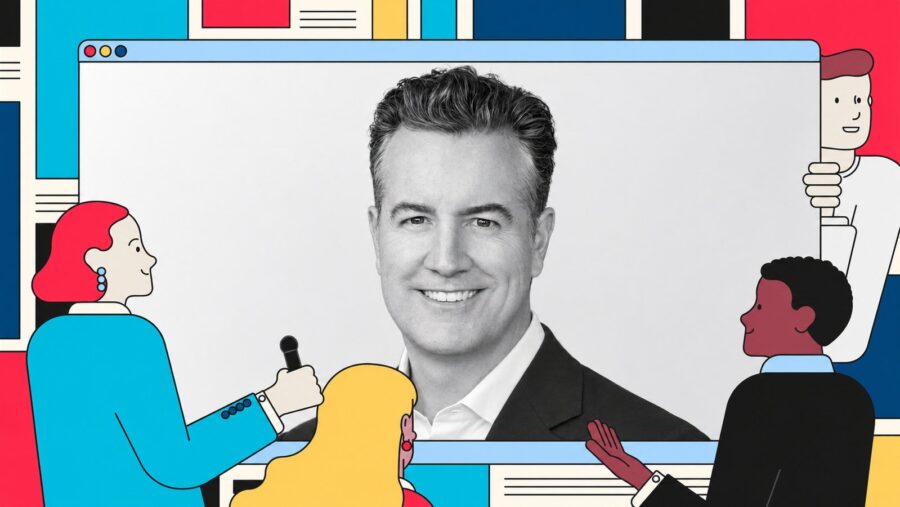
For Coursera CEO Greg Hart, a productive day is one in which the company has made progress: improving the experience for learners, running the business better and focusing on the right priorities.
“Did we improve over the course of the day in everything that we’re trying to do?” he asks.
Hart spent much of his career at Amazon before joining Coursera, drawn by its mission to make education accessible to anyone, anywhere. He is now overseeing the integration of Coursera and Udemy, which completed their combination in May 2026, while developing another learning platform for 2027.
The work has him reconsidering what people need from education and how employers know whether it has worked.
Learning still takes effort
Hart sees a mismatch between businesses’ investment in artificial intelligence and the training given to employees expected to use it. Hart spells out the imbalance. “There’s an immense amount of investment in AI technology,” he says, “but there isn’t an equal corresponding investment in helping people build the skills they need to leverage that technology effectively.”
He cites Aon’s 2026 Human Capital Trends Study: nearly three-quarters of organisations have deployed or piloted AI, but only 18% say most of their workforce has taken part in AI training or reskilling over the past year.
Technical knowledge is only part of the picture. Hart also sees demand for critical thinking, communication, judgement and leadership, and he’s concerned that using AI to finish an assignment may leave someone with little understanding of how the work was done.
“For true learning, you actually want a little bit of productive struggle,” he says. “You’re not going to learn anything just by having somebody else do it for you, whether that’s another person or AI.”
Employers should start with basic AI literacy, he argues, then offer training relevant to specific jobs. “To get real business benefit out of it,” he says, “you can’t just give AI training.”
At Coursera, employees share experiments in monthly ‘AI Spark’ meetings. A specialist team helps departments build tools for their own workflows, then teaches staff to operate and improve them. The department should be able to carry on without the specialists.
What the merger brings together
Coursera and Udemy approach education from different directions. Coursera draws on university and technology-company partnerships while Udemy works with a large network of instructors whose expertise comes from their professional lives.
Hart describes them as “working practitioners” who are “very close to what is needed in work in the moment.” That allows them to create courses quickly as workplace demands change.
The two companies also had different revenue mixes. Before the combination, roughly two-thirds of Udemy’s revenue came from its enterprise business, while Coursera’s proportions were the reverse.
Hart sees the appeal in the numbers. “By combining them you actually get a very balanced business that is roughly 50/50,” he says. He also sees an opportunity to avoid having two companies investing separately in much of the same work.
Rather than transfer features between the existing platforms, Hart decided to build something from scratch.
“We thought it made more sense to build an AI-native platform,” he says, with “much more of a focus on skill delivery.”
The result is ‘Project Helix’, intended to offer more interactive lessons and clearer evidence of what learners can do. Hart expects it to become broadly available to enterprise customers in the first half of 2027, with individual learners following later in the year.
A better connection with instructors
Hart believes some of the most engaging learning happens with “an amazing instructor and a small group of students.” What makes the small classroom special, he explains, is the “interaction and back and forth” between the teacher and students, as well as among the students themselves.
Online courses have traditionally relied on videos, readings and quizzes. Hart wants instructors to have more ways to engage learners. “We have role plays,” he says, describing what’s possible. “We have dialogues which instructors can insert into their courses that enable Socratic dialogue with students.” Graded labs offer another opportunity to practise.
For instructors, that means learning to create activities alongside traditional lectures. Hart has heard from Udemy instructors who want to see the company “not just investing in new technology, but also in creating new ways for them to connect with their students.”
“We’re going to continue to improve the tools that you have to create better learning experiences,” he says. A recorded lesson will remain an option, but he expects more interactive courses to appeal to learners.
Make the learning count
Finishing a course does not necessarily show an employer what someone can do. Hart points to ‘EY Badges’, a professional development programme that awards digital credentials for learning and demonstrated workplace application. EY works with Coursera to provide employee training.
The badges are “a real motivator,” Hart says. A Coursera case study backs him, reporting that the badges influenced recruits’ decisions to join EY and were associated with higher retention among top talent.
“The badges correlated with better retention,” he says. That does not establish whether the badges themselves encouraged people to stay.
Helix takes a related approach to assessment. Hart wants to move beyond “just completing a course and getting a check mark” to provide “real proof that you’ve built and learned a skill that you can apply in the real world, in the workforce.”
Getting there will be complicated. Hart acknowledges the work still ahead.
“We’re still in the middle of that integration,” he says. That leaves him with plenty to do in 2027. He must keep two existing platforms running while building a third, one whose value will depend on what learners can actually do after finishing their courses.
Editor’s Note: Every year, business leaders are asked what they think will happen next. But the decisions they’re making now are often far more interesting. In The 2027 Playbook, Raconteur speaks with executives across industries about their priorities for the year ahead: where to invest, how to equip their people and which risks demand attention. Their answers span AI, skills, financial discipline, regulation and trust. A recurring question connects them: how do you turn ambition into results while keeping the business resilient and people accountable?
For Coursera CEO Greg Hart, a productive day is one in which the company has made progress: improving the experience for learners, running the business better and focusing on the right priorities.
“Did we improve over the course of the day in everything that we're trying to do?” he asks.
Hart spent much of his career at Amazon before joining Coursera, drawn by its mission to make education accessible to anyone, anywhere. He is now overseeing the integration of Coursera and Udemy, which completed their combination in May 2026, while developing another learning platform for 2027.
