This year’s World Economic Forum (WEF) – the annual five-day gathering of political and business leaders in the Swiss mountain resort of Davos – carries an added sense of urgency.
After supporting efforts to unseat Venezuela’s leader and renewing his ambition to claim Greenland, the US president has escalated matters further with new tariff threats aimed at European allies resisting that push. Europe’s response – proposing retaliatory duties on $108bn (about £80bn) worth of American goods – has transformed the annual meeting of global powerbrokers into a possible flashpoint for escalating geopolitical confrontation, testing the WEF’s stated commitment to a “spirit of dialogue”.
Escalating global tensions and President Donald Trump’s return to Davos for the first time since 2020 have propelled attendance to record levels. As many as 3,000 leaders from nearly 130 countries have convened in the Swiss Alps this week, alongside roughly 850 senior executives.
For business leaders, the annual meeting is a strong indicator of what might happen in the next 12 months. Here are the key questions they will be asking.
Will geopolitics overwhelm growth?
Even before Trump unveiled new tariff threats, it was clear that geopolitics would dominate topics of conversation at Davos.
Ahead of the meeting, the World Economic Forum published its 2026 Global Risks Report, asking business leaders, academics and policymakers to rank the threats they see as most urgent from a predefined list. Geo-economic confrontation, the spread of misinformation and disinformation, and deepening social polarisation emerged as the three most significant risks facing the world over the next two years.
The immediate questions for executives in attendance are familiar: will the tariffs be implemented, or is this posturing? And if levies are imposed, will UK and European leaders retaliate or seek to calm the waters?
For many attendees, Wednesday looms as a pivotal moment, with meetings scheduled with President Trump that could offer clearer signals on whether confrontation or compromise lies ahead.
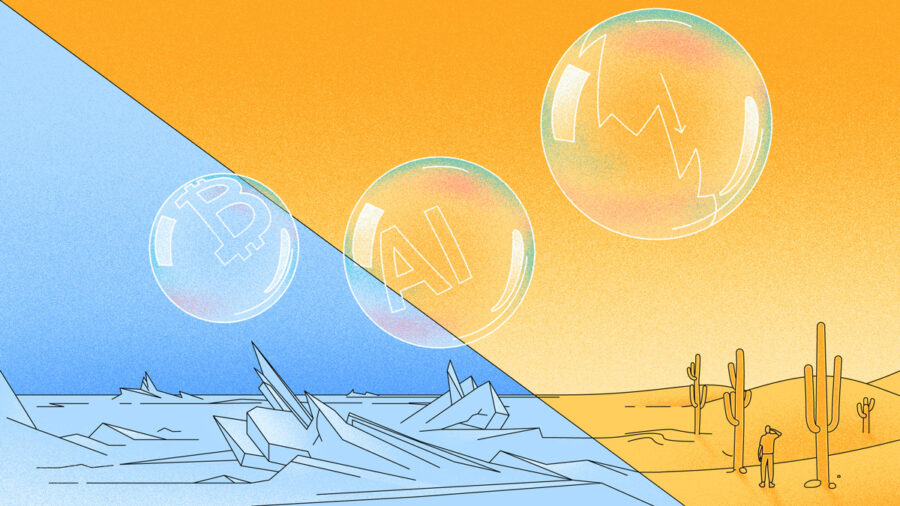
What happens if the ‘triple bubble’ bursts?
Adding to the unease in Davos is growing chatter in financial circles about the risk of a market correction driven by an AI bubble. Concerns over stretched technology valuations – and the consequences of a sharp reversal – have been raised by figures ranging from the governor of the Bank of England to the chief executive of Google’s parent company, Alphabet.
But it is not just an AI bubble people are watching out for. Experts warn that financial markets may be approaching not one but three potential bubbles. Beyond AI, a sharp drop in Bitcoin’s price has reignited fears of a wider cryptocurrency slump. At the same time, soaring global public debt – now above $100tn (about £74tn) – is adding to concerns about financial stability.
These risks are tightly linked, each reinforcing the others. Corporate leaders at Davos this week will be keen to grasp what the fallout could be if a so-called triple bubble were to inflate further – and then burst.
What is AI’s impact on the jobs market?
One of the biggest questions hanging over the advance of AI and automation is whether it will trigger a job armageddon. In Davos, corporate leaders will be weighing the evidence carefully.
The World Economic Forum’s Future of Jobs Report 2025 estimates that about 92 million roles could be displaced worldwide by 2030 – the most significant upheaval in labour markets since the industrial revolution. Yet the same report projects the creation of 170 million new jobs over the same period.
For now, the outlook is not one of outright collapse. Most companies say they have yet to deploy AI in ways that deliver meaningful productivity gains. Research from the Massachusetts Institute of Technology suggests that 95% of organisations using AI have so far seen no measurable return on their investment.
That may not last. AI’s impact on employment is expected to become more visible in 2026, with growing anxiety about prospects for recent graduates. New research from the International Monetary Fund indicates that wages and employment are already coming under pressure in roles most exposed to automation, prompting calls for governments to strengthen support for workers displaced by the technology.
How can green growth be achieved?
One of the five central global challenges highlighted under the meeting’s headline theme is: how can prosperity be achieved within planetary limits?
Any conversation about tackling climate change, however, must contend with conflicting realities: the planet is experiencing one of its hottest periods on record and the political and scientific efforts to confront it are coming under growing strain.
In the UK, the long-standing cross-party consensus around net zero emissions fractured last year. In the US, President Donald Trump has begun withdrawing the country from a range of climate initiatives, including the Paris Agreement and the UN’s climate science body, while pledging to expand fossil fuel production.
Businesses, too, have shown signs of retrenchment. Last year, Airbus delayed plans to fly a zero-emissions aircraft powered by green hydrogen by 2035, while HSBC pushed back parts of its climate targets by two decades.
Yet the feared wholesale collapse in climate action has not materialised. Most countries have so far maintained their climate targets, even as scientists warn progress remains far too slow to avert the worst impacts of global warming. Many companies, meanwhile, remain keen to understand how growth can be reconciled with sustainability.
A new report, Already a Multi-Trillion-Dollar Market: A CEO Guide to Growth in the Green Economy, suggests that despite economic uncertainty, investment in green technologies continues to hit record highs. In Davos, business leaders will be asking how to sustain that momentum, and how to build a credible commercial case for green initiatives amid slower growth, tighter capital and increasingly fragmented regulation.
This year’s World Economic Forum (WEF) – the annual five-day gathering of political and business leaders in the Swiss mountain resort of Davos – carries an added sense of urgency.
After supporting efforts to unseat Venezuela’s leader and renewing his ambition to claim Greenland, the US president has escalated matters further with new tariff threats aimed at European allies resisting that push. Europe’s response – proposing retaliatory duties on $108bn (about £80bn) worth of American goods – has transformed the annual meeting of global powerbrokers into a possible flashpoint for escalating geopolitical confrontation, testing the WEF's stated commitment to a "spirit of dialogue".
Escalating global tensions and President Donald Trump’s return to Davos for the first time since 2020 have propelled attendance to record levels. As many as 3,000 leaders from nearly 130 countries have convened in the Swiss Alps this week, alongside roughly 850 senior executives.