
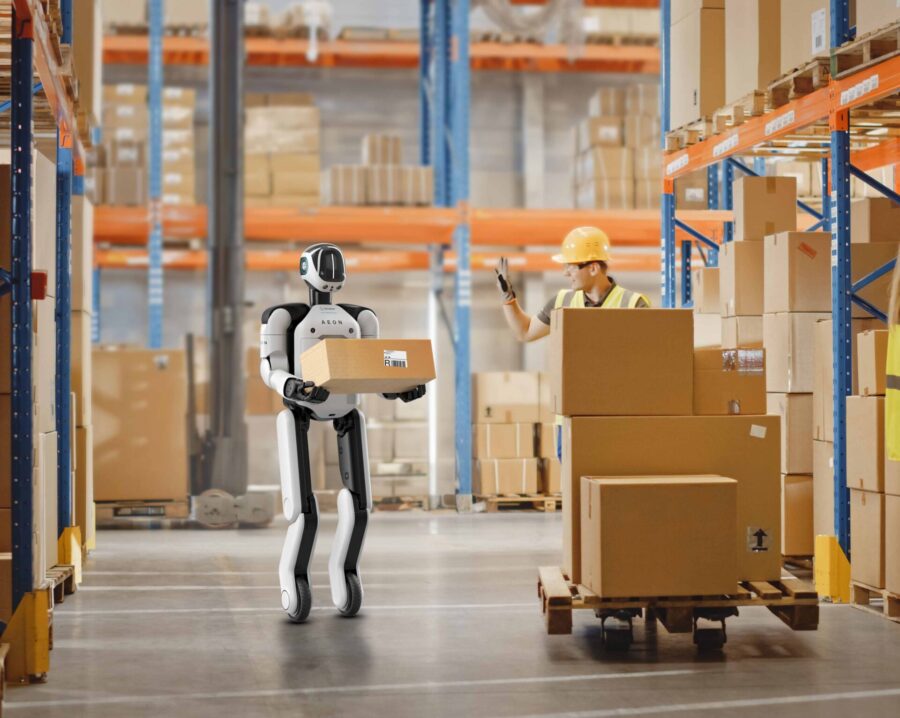
Much of the debate about robots at work centres on which jobs they might eventually replace. For employers, a more immediate question is actually how to divide work. Which tasks should a machine take on? What would make that useful to the people around it? And which decisions should remain in human hands?
These choices will shape how robotics changes working life. They will also determine whether employees see a useful addition to their workplace or a technology whose purpose they struggle to understand.
Expectations start with the task
Hexagon’s Robot Generation study, drawing on more than 18,000 adults and children across nine countries, suggests people already make quite careful distinctions about the work they would welcome robots doing and how sharply expectations vary.
For example, some 68% of adults would choose a robot to lift and transport heavy items. Just 12% would choose one to care for someone who is sick, elderly or a child.
There is a practical logic here. The appeal of handing over strenuous, repetitive work is easy to understand. Care involves a different relationship: recognising distress, interpreting what someone needs and deciding how to respond.
However, these preferences should not be seen as binary yes/no questions. Instead it should prompt businesses to examine the tasks within a job more closely. While people may not be comfortable with a robot providing care to loved one directly, that scenario could still benefit from robots transporting supplies while people concentrate on patients. Reluctance to receive care from a robot does not rule out a useful role for robotics around that care.
Thinking at this level makes the opportunities for robotics more concrete. It allows employers and employees to discuss where a robot could help and what they would want that help to achieve.
Enthusiasm comes with conditions
Children offer an encouraging insight into how that future could be realised. Fully eighty per cent feel excited about robots, compared with 59% of adults. Asked specifically about working alongside a robot colleague, 59% of children express excitement, against 40% of adults.
But enthusiasm should not be mistaken for unconditional acceptance. Forty-one per cent of children worry that robots could malfunction and cause harm, exactly the same proportion as adults. Concerns about robots replacing human jobs are also similar: 39% of children and 41% of adults.
This insight is more useful than a simple story about optimistic children and anxious adults. Yes, the next generation can imagine working with robots. But greater enthusiasm does not remove the need for reassurance about safety or the changing nature of the workplace.
Businesses should take both responses seriously. If automation changes staffing needs or removes tasks people value, employees deserve a clear explanation of what will change and what support will be available. Enthusiasm for the technology cannot substitute for that conversation.
Defining what ‘good’ means
Assuming that a useful role has been identified, the next question is what standard the robot must meet.
Consider a robot vacuum cleaner. If it cleans three-quarters of your floor, you might still consider it useful because you can sweep the corners it missed. If a robot picking parts for a production line gets it right only three-quarters of the time, that is an unacceptable failure rate.
Our expectations change because the consequences change. At home, some missed dust may be a tolerable inconvenience. On a production line, repeated picking errors could interrupt operations or compromise the finished product.
This makes defining success a practical task for the business. How accurate must the robot be? Under what conditions must it maintain that accuracy? How will performance be checked?
Precision measurement, like that enabled by Hexagon’s technology, is central to answering these questions. A robot handling a component needs accurate information about its position and surroundings. It must locate the part and position its movements appropriately. Errors in that understanding can affect everything that follows.
Before any deployment or shift in working practices, businesses need strong evidence that a robot can meet the required standard throughout everyday operation.
Keeping human judgement meaningful
Even a clearly defined task will encounter exceptions. A component may arrive damaged, a workspace may change, or a result may look plausible while concealing a problem. Someone needs to recognise when the usual process no longer applies.
This is where human judgement becomes a working responsibility. Employees need to understand the system’s limits and have the authority to intervene. Naming a supervisor achieves little if that person lacks the information or time to challenge what the machine is doing.
Experienced workers have an important contribution to make. A person who understands why an apparently minor variation matters can be essential to deciding whether an automated process is performing acceptably. Their knowledge should inform both deployment and training.
The human capabilities businesses will need
Our research points towards these broader dependencies between human labour and robots. Asked what schools should prioritise for a future shaped by robots and AI, adults placed data and privacy awareness first, followed by creative and critical thinking, ahead of coding and programming.
Those priorities have implications for employers too. Technical expertise will remain necessary to build, integrate and maintain robotic systems. Alongside it, businesses will need people who can question a result, recognise a problem outside the machine’s remit and judge when efficiency is the wrong measure of success.
Creativity deserves equal attention because introducing a robot creates choices about how work could be organised differently.
If a machine takes over heavy lifting, for example, a business could simply increase the pace of the existing process. It could also reconsider the workstation, make the role accessible to more people or give employees greater scope to resolve recurring problems. Those possibilities require imagination and an understanding of the work beyond the automated task.
Employees should have opportunities to help develop and test those ideas. Asking employees what they would change about a process can reveal possibilities that a narrow focus on throughput would miss.
This gives creativity a clear place in preparing for robotics: helping people envisage better ways of working and assess whether technology can make them possible.
The future is coming. Prepare now.
Preparing the next generation therefore means more than familiarising young people with intelligent machines. It means giving them opportunities to solve problems, test assumptions and take responsibility for decisions. The same opportunities should be available to people already at work.
The Robot Generation may arrive with greater enthusiasm for robotics but it will still need workplaces that use the technology well. Business leaders can prepare now by defining useful roles for robots, demonstrating that they can meet the standards those roles require, and investing in the people who will work alongside them.
Much of the debate about robots at work centres on which jobs they might eventually replace. For employers, a more immediate question is actually how to divide work. Which tasks should a machine take on? What would make that useful to the people around it? And which decisions should remain in human hands?
These choices will shape how robotics changes working life. They will also determine whether employees see a useful addition to their workplace or a technology whose purpose they struggle to understand.
