Who’s in charge when AI starts negotiating your contracts?
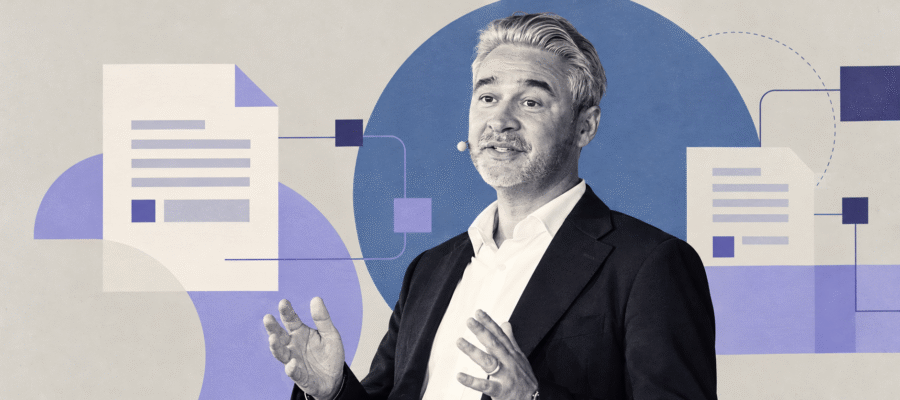
The day before this interview, a customer startled Stéphane Barberet by asking whether AI agents could negotiate contracts on the company’s behalf.
“I was like, wow, OK,” he recalls. But the customer was serious and wanted an answer.
“Autonomy is not really a binary choice,” Barberet argues. An AI agent might handle routine negotiations using standard clauses, clear policies and defined approval thresholds, but unusual liabilities or major concessions should still be escalated to people. “The right question is not ‘can AI negotiate everything?’ It’s ‘can we clearly define what an agent is authorised to do, show what it did and put humans back in control whenever the risk demands it?’”
As Docusign‘s general manager for Europe, the Middle East and Africa, Barberet spends much of his working day talking to customers. Those conversations increasingly turn to what businesses can safely hand over to AI — and what should remain in human hands.
Authorisation, automation, autonomy
Authorisation, automation and autonomy offer a shorthand for the future Barberet describes, provided businesses know when software should stop making decisions. Docusign’s expansion beyond electronic signatures reflects another concern for Barberet, which is what happens after a contract is signed. He believes businesses can lose value because nobody tracks the promises made in it.
He identifies three sources of lost value: obligations that never turn into action, commercial entitlements that go unclaimed and a lack of ownership across departments. Consider a supplier contract with an annual rebate. Procurement negotiates it, but finance never learns about it. Nobody claims the money.
“The rebate that was in the contract goes unclaimed because nobody knows that there is even a rebate in the contract,” he explains. A contract, in his view, should be treated “not as a static PDF to be archived, but as a living source of business instructions.”
Where do the humans go?
Yet AI cannot fix a broken process by itself. Barberet has argued that technology delivers little value when it is added to broken processes, and he returns to accountability when asked when a workflow is ready for automation. Someone must set the policies, someone must own the commercial result and someone must ensure the work reaches the right people. Without that division of responsibility, AI risks magnifying the confusion.
“The workflow is where most of the value resides,” he says. For European customers, he adds, questions of data security, residency and governance have become increasingly pressing, especially when the supplier is based in the US. They deserve “precise answers, not slogans.”
But what happens to people when software can do more of the work itself? When pressed further on where humans will fit if AI becomes fully autonomous, Barberet is candid about the possible disruption.
“It will certainly change the task,” he says. “It would be unrealistic, honestly, to say otherwise.” Some entry-level roles may disappear. He questions how much time skilled workers spend on routine tasks such as locating documents, copying information and chasing approvals. “Maybe a more interesting way of asking the question is how much expert capacity today is currently absorbed by low-value work.”
His hope is that legal, procurement and sales professionals will have more time for judgement, relationships and complex decisions. There is no guarantee that every existing role will survive unchanged, but he describes himself as more of a glass-half-full person.
“Again, it would be unrealistic to believe that nothing is going to happen,” he says. “Things will happen.” Still, he sees people moving towards work that delivers more value for themselves and their employers.
A life on the road
Barberet has seen the demands of business change throughout his career. Earlier on, he spent about two weeks a month in Boston. What began as enjoyable travel became an ordeal.
“I’m not getting younger,” he admits. Travelling to the US every other week became “the most painful part of my job”. He remembers Asia differently — work also took him to Japan, where he was tasked with fixing a business operation. “I actually fell in love with this region, and especially with Japan.”
Today, he still travels frequently, largely within Europe. His working day starts early and ends late, and customer conversations fill much of it.
“There is probably not a day where I’m not talking to customers,” he says. He wants to know what keeps them awake at night. Increasingly, those conversations are about how much of the work businesses can entrust to machines.
And acceleration
Looking towards 2027, Barberet wants European businesses to connect the systems they have spent years improving separately. Sales has its software, finance has its own and HR another. But a single agreement can involve all three, creating commitments that last for years.
“The next wave of transformation needs to connect the work between systems,” he argues. “For me this is an organisational challenge as much as the technology one.”
For Docusign’s next fiscal year, he has another A in mind: acceleration. Having spent time explaining the problem of neglected agreements to customers, he believes the company is ready to move faster. That makes four: authorisation, automation, autonomy and acceleration. His excitement is plain, but so is his insistence that the boundaries of AI must be clear.
“The trust comes from boundaries and auditability,” he says. For Barberet, acceleration is the exciting part. Yet authorisation, automation and autonomy will determine what that progress looks like in practice. Whether AI ends up negotiating the deals in the future, it will not be the one living with the terms, after all.
Who's in charge when AI starts negotiating your contracts?
The day before this interview, a customer startled Stéphane Barberet by asking whether AI agents could negotiate contracts on the company's behalf.
“I was like, wow, OK,” he recalls. But the customer was serious and wanted an answer.