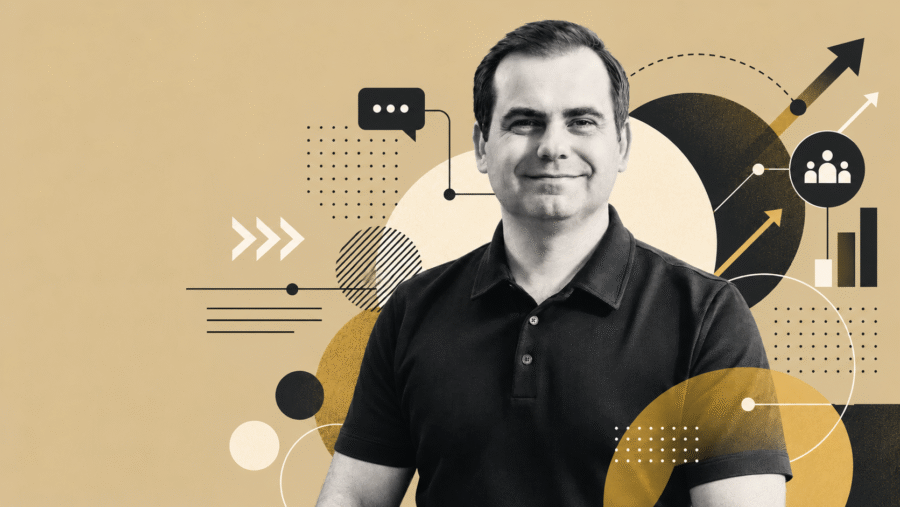
The members of DeepL’s Japanese team used to speak English with their colleagues during overseas calls, but they found it limiting. Jarek Kutylowski, founder and chief executive of the German AI translation company, says they found it difficult to express themselves because the language is complicated.
“I’ve seen people actually wake up emotionally when they start speaking a language that they speak very well, or their native language,” he says. “They’re far more themselves. They’re far more authentic. They’re far more convincing, even, in what they’re saying.”
Now team members use DeepL’s real-time meeting translation to speak Japanese, allowing them to contribute in the language they know best.
When fluency becomes optional
The last time Kutylowski spoke to Raconteur, in 2024, he predicted that professional language skills would become less important. Two years later, he says some DeepL customers have stopped requiring proficiency in particular languages when recruiting.
“We have customers now who have actively said we are not hiring for that language skill anymore,” he says. “We’re hiring for the functional skill of a person. If they speak the other language, amazing. That’s going to help them.”
He cites the difficulty a French business might face finding someone who understands its products and speaks Greek to serve customers there.
“Has the whole market adopted that? No, not yet,” he says. But he rejects the suggestion that learning English is no longer worthwhile. Fluency still offers instant understanding, without waiting for technology to interpret speech or facial expressions. Nor does he expect English to lose its position as the international business language.
“I don’t see any signs of English being replaced,” Kutylowski says. “If you can communicate in any language and you can make yourself understood through technology, the power of local languages rises a little bit.” He knows the peculiarities of multilingual life personally. He counts instinctively in Polish but finds it difficult to discuss business in the language. Speaking German to his Polish wife feels unnatural.
What the words don’t say
DeepL introduced real-time voice-to-voice translation in April, moving beyond written text, but some obstacles remain. The German and Japanese languages, for example, often place crucial information at the end of a sentence. DeepL uses context and prediction to anticipate what a speaker will say, but what happens if someone is interrupted?
“If it’s an unfinished sentence, we have to translate the unfinished sentence,” Kutylowski says. “We’re trying not to overpolish things.” Otherwise, the result risks becoming an AI summary rather than a faithful translation.
He’s unequivocal when asked whether AI can eventually recognise sarcasm, humour, facial expressions and cultural nuance.
“Oh yeah, totally,” he says. “AI is already amazing at capturing these things.”
He recalls struggling to follow a workshop delivered in fluent but Swedish-accented English. Instead of concentrating on the unfamiliar accent, he listened to an AI translation in Polish, which “made it more accessible … in a way that was easier to digest.” The experience shows how AI can make unfamiliar speech easier to follow.
But it tells us less about whether technology can detect irony or interpret the intention behind a remark. Still, Kutylowski remains confident.
“It will probably be better at figuring out some of those clues that are coming through in facial expressions and how you’re standing, how you’re behaving,” he says. “Maybe it’s going to be even better than we are at this.” His outlook extends to the future of human interpreters. “Realistically, the need for that is starting to go away,” he argues, referring to the linguistic and technical aspects of the job.
But questions of liability remain unresolved.
“We haven’t yet figured out how we deal with accountability and liability with AI in general,” he says. DeepL is discussing with customers when human oversight remains necessary.
The business of sounding human
Kutylowski sees businesses moving from translation tools used occasionally by employees to systems built into everyday operations. He recounts a conversation with the chief technology officer of an unnamed large technology company which used AI to reduce software localisation — adapting software for different languages and markets — from days to just five minutes. The result, he argues, changes how quickly a business can respond to its customers.
“Now the iteration cycles are different, and you can even work with your customers in a different way,” he says. “You have a request from a customer, and you can tell them, ‘It’s going to be done today.'”
Kutylowski says his ambitions extend beyond efficiency for 2027. The company’s New Voice models released in September already aim to preserve a speaker’s tone and delivery. He wants translations to reflect emotion more faithfully, from excitement to sadness.
“The ability to really mimic emotions and the way you’re speaking in the other language is just getting into the right shape,” he says.
DeepL has even spoken to businesses in the dating industry about conversations between people who do not share a language. “For that, you really have to be strong on the human emotion side of things, because this is what carries the conversation,” he says, though he recognises that convincing businesses and consumers to trust such technology will take time.
“It’s a very, very new technology,” he concedes. “There is still some scepticism and questions in the market about that.”
DeepL is determined to make its AI as adept as people at navigating everyday communication, whether in the workplace or elsewhere. One can only hope that the human connection does not get lost in translation.
The members of DeepL's Japanese team used to speak English with their colleagues during overseas calls, but they found it limiting. Jarek Kutylowski, founder and chief executive of the German AI translation company, says they found it difficult to express themselves because the language is complicated.
"I've seen people actually wake up emotionally when they start speaking a language that they speak very well, or their native language,” he says. “They're far more themselves. They're far more authentic. They're far more convincing, even, in what they're saying."
Now team members use DeepL's real-time meeting translation to speak Japanese, allowing them to contribute in the language they know best.
