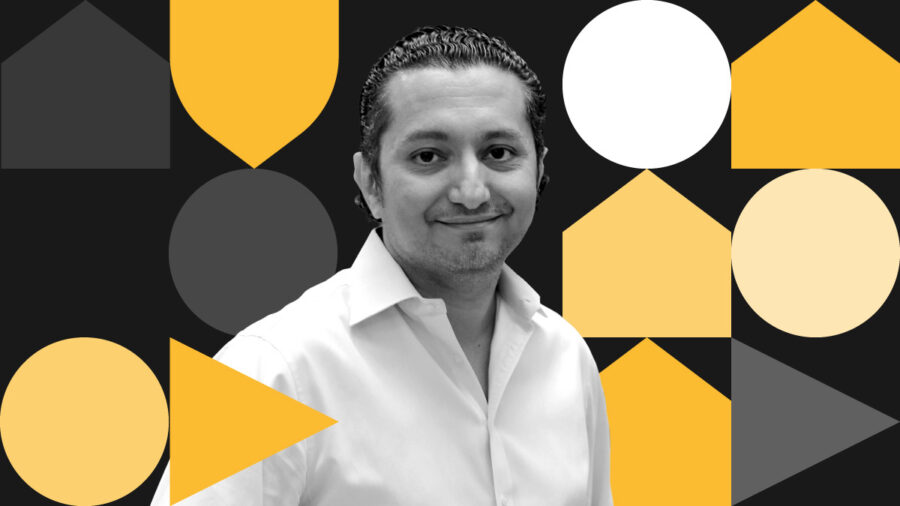
Babek Ismayil still starts his day like a trader. Before meetings, the OneDome founder and CEO checks Asian markets, scans the US headlines and looks for anything that might have shifted investor sentiment.
“I’m an ex-trader, so it’s a kind of habit that I can’t stop,” he says.
The way he looks at companies has carried over too. Before starting OneDome, Ismayil worked in high-yield and distressed debt, including at JPMorgan, analysing why businesses got into trouble and whether they could be fixed.
“Having a credit hat always allows you to be a bit more sceptical about everything,” he says. “When you’re an equity person, you always see things positive. When you’re a credit person, you always think about the downside.”
That scepticism is relevant for these times. UK fintech investment fell to £1.8bn in the first half of 2026, from £5bn a year earlier, according to KPMG, while deal numbers hit a decade low. Ismayil does not see that as evidence that investors have turned against the sector. His view is that good businesses can still raise money even when investors become more selective.
“For the right company, there’s always funding,” he says.
Scarcer capital is changing the test of what makes a good fintech business. For much of the past decade, the fintech playbook was to improve one financial product and build a specialist business around it. Ismayil does not think that model is dead.
“In some instances, being focused on one thing is absolutely the right thing to do,” he says, “assuming that the unit economics stack up, the financials make sense and the problem that business is solving actually solves the customer problem in completeness.”
The limits of specialisation are easier to see in homebuying. Customers may need a mortgage, legal services and a survey, but those are steps towards the outcome they actually want.
OneDome has built around that distinction. Rather than treating mortgages, conveyancing and other services as separate products, Ismayil wants to treat the home purchase itself as the product.
“When we look at homebuying, trying to solve a single element of it helps the customer, but it doesn’t really solve the customer problem,” he says. His question is simple: “Can we productise the whole thing rather than look at them still as individual verticals?”
He compares the model with ecommerce. On Amazon, customers do not separately arrange payment and delivery. Those functions are all baked into the transaction.
“You don’t worry about how the money will go from your bank account to the seller’s bank account, and you certainly don’t worry about how a delivery company is going to grab that item from the seller and bring it to your doorstep,” he says. “That’s all sorted.”
Homebuying still works very differently.
“Homebuying is very complex. There are too many moving parts,” Ismayil says. “There are too many things they need to figure out and also project-manage the whole thing.” There is an obvious commercial upside to solving more of that process. Ismayil says the model can improve acquisition costs, conversion, lifetime value and margins. So, the obvious question is whether this amounts to anything more than cross-selling.
Ismayil’s answer is that integration only works if it improves the outcome for the customer. OneDome has moved from connecting different parts of the transaction towards owning more of them, including mortgage brokerages, which he says gives it greater control over standards.
“When we own the journey,” he says, “we can guarantee standards and customer experience that we really like the customer to have.”
Ownership also makes OneDome responsible when something goes haywire.
“We cannot stand in front of the customer and guarantee them a certain level of experience without actually being accountable for it,” he says. “At least if we make a mistake, that will be on us.” He expects that model to push more consolidation across financial services, particularly where technology-led companies can acquire traditional businesses and fold them into a better digital experience.
“We start to see that in financial services as well,” he says, “where some companies with the better user experience and better technology acquire traditional businesses and integrate them within their platform.”
The former distressed-debt investor still comes back to the numbers.
“It comes down to unit economics and the overall plan for the business,” he says. He is not opposed to companies losing money. He is opposed to businesses that cannot explain how the losses end. “It’s okay for a business to lose money if there is a very clear plan on how the business will turn around, and that’s a defendable plan.”
For OneDome, the ambition goes further.
“Our goal is to consolidate all the services around households’ balance sheet,” he says. He describes the destination as a “home ownership operating system,” starting with the property purchase and expanding into the other financial needs that follow.
Fintech spent years unbundling financial services into specialist products. Ismayil is betting that the next opportunity lies in putting them back together around the customer. His argument comes down to something much simpler, especially for homebuyers.
“They just want to buy property,” he says.
Babek Ismayil still starts his day like a trader. Before meetings, the OneDome founder and CEO checks Asian markets, scans the US headlines and looks for anything that might have shifted investor sentiment.
“I’m an ex-trader, so it’s a kind of habit that I can’t stop,” he says.
The way he looks at companies has carried over too. Before starting OneDome, Ismayil worked in high-yield and distressed debt, including at JPMorgan, analysing why businesses got into trouble and whether they could be fixed.