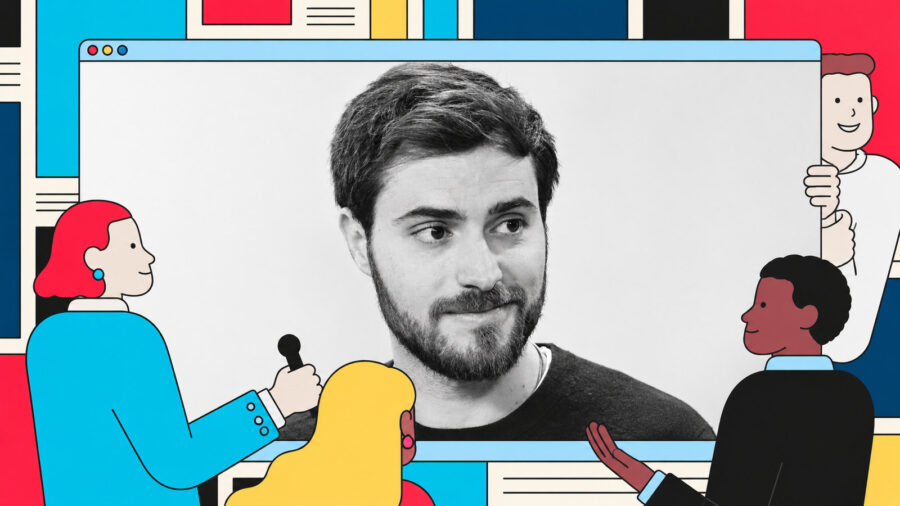
A familiar face appears on a video call. The voice sounds right and the instructions seem reasonable. But the person on the screen could be a convincing fake.
For banks, distinguishing genuine customers from AI-generated impostors is becoming harder. Yet another challenge is emerging: legitimate customers may increasingly want AI assistants to manage transactions and interact with financial services on their behalf.
The question is no longer simply how banks can keep bots out, but how they can decide which ones to let in. According to Tiago Sada, chief product officer at Tools for Humanity, financial institutions need to address both problems as AI becomes more deeply integrated into financial services.
“When everything can be faked, you don’t know who and what to trust,” he says.
A familiar face is no longer enough
For Sada, existing identity checks are becoming less reassuring as artificial intelligence makes convincing fakes easier to produce.
“KYC is not enough because you can fake that with AI,” he says, referring to the know-your-customer checks banks use. “Just looking at your face on Zoom is not enough because you can fake that with AI.”
His company’s World ID is designed to prove that someone is a real, unique human. In October, World introduced an offering for financial services, naming Bain Capital and OpenExchange among its initial design partners.
Sada argues that proof of humanity should complement, rather than replace, legally required KYC checks, adding another layer of verification to existing identity procedures.
Knowing that someone is a unique human is not the same as confirming their legal identity. It also says nothing about whether they have approved a particular payment.
Letting AI act on our behalf
Banks may soon face the opposite problem: allowing AI assistants to act for customers who have authorised them.
“There’s still a lot of bad bots, but there’s also a lot of good bots now, like a lot of bots that are representing users,” Sada says. He believes websites face a growing challenge in deciding which AI agents to trust, comparing the delegation of authority to granting an agent a form of power of attorney.
World’s AgentKit is designed to let people share certain verification credentials with AI assistants acting on their behalf. Rather than impersonating a customer, the assistant can identify itself as a bot and demonstrate that a verified person has authorised it to use those credentials.
The distinction matters for banks. Proof that an AI assistant is acting for a real person is not the same as permission to access an account, transfer money or complete a purchase. Those decisions still require separate controls.
AgentKit remains in beta, although Sada says some partners already use it in production. There is no indication from that claim alone that the technology has been widely adopted by banks.
“I think that talking with sites, they don’t want to be blocking all the bots,” he says. “They’re just doing it because it’s really insecure right now.”
Banks will have to decide which accounts an agent may use, how much it may spend and when the customer must approve a request personally.
When an agent oversteps
An AI agent might have permission to shop for its owner. That does not mean every purchase it makes is one the customer intended.
“If your agent comes and buys shoes, and that agent had your credit card and you had approved it to do so, then certainly the site shouldn’t have to cover that loss,” Sada argues. He expects users of self-run, open-source agents to bear more responsibility. “You’re running your own agent,” he adds. “If that agent misbehaves, you’re responsible for what it does.”
Sada predicts that commercial AI providers such as OpenAI and Anthropic may eventually face greater responsibility for their agents’ actions, although the legal boundaries remain unsettled.
The UK’s Competition and Markets Authority says businesses deploying AI agents remain responsible for complying with consumer law, even when another company provides the technology. Its guidance does not decide who pays when a customer’s own agent goes beyond its instructions.
For banks, a record of what customers have approved could prove vital when transactions are disputed. Customers will also need ways to stop or challenge payments they did not authorise.
The price of proving you’re human
Stronger checks can protect customers, but they can also make everyday banking harder.
“No business wants to add a bunch of extra steps to their flows,” Sada says. “Any step that you add reduces business.”
World offers different ways to verify people. Its Orb checks whether someone is a unique human. Smartphone selfies can confirm their presence and identity documents can verify particular details. These checks offer different levels of assurance.
World says the Orb encrypts images of a person’s face and irises, transfers them to the person’s phone and deletes its copies. Information derived from iris images is also split into fragments and checked through a separate system to prevent duplicate registration. Websites using World ID receive cryptographic proof rather than the original images.
“Just like you cannot trust websites to safeguard your passport, you should certainly not trust them to safeguard your biometrics,” Sada says.
European regulators have scrutinised the system. Bavaria’s data protection authority ordered corrective measures in 2024. The company said it would appeal. Tools for Humanity postponed a planned return to Spain after a warning from its data protection regulator in February 2026.
The challenge, Sada argues, is finding the right balance between security and convenience. Not every interaction requires the same level of scrutiny, particularly when the potential consequences vary so widely.
“That trade-off looks different for a bank that is going to give you a mortgage to a social network where you’re simply going to like a post,” he says.
He also sees opportunities beyond preventing fraud. “There’s another side of the coin,” he says. “There’s also a question of what new things can proof of human enable that weren’t possible before.”
As AI agents become more involved in banking, financial institutions will need to distinguish between proving that a customer exists and establishing what that customer has actually authorised.
For Sada, proof of humanity is part of the answer. The harder challenge for banks may be deciding where an AI assistant’s authority begins and ends, and who takes responsibility when it goes too far.
A familiar face appears on a video call. The voice sounds right and the instructions seem reasonable. But the person on the screen could be a convincing fake.
For banks, distinguishing genuine customers from AI-generated impostors is becoming harder. Yet another challenge is emerging: legitimate customers may increasingly want AI assistants to manage transactions and interact with financial services on their behalf.
The question is no longer simply how banks can keep bots out, but how they can decide which ones to let in. According to Tiago Sada, chief product officer at Tools for Humanity, financial institutions need to address both problems as AI becomes more deeply integrated into financial services.
