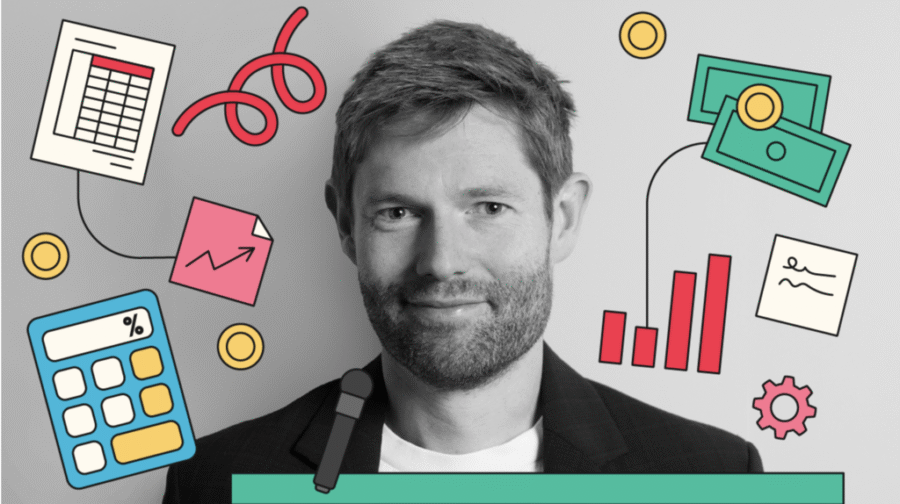
Alistair Gurney is CFO of Lucanet Group, a CFO software platform that supports finance consolidation, close processes, tax computation, lease accounting, FP&A, disclosure management, presentation, and XBRL tagging.
He joined Lucanet in May after more than 15 years across public and private equity-backed software businesses. His current role gives him a direct view into both sides of finance technology. He leads a finance function while working inside a company that builds tools for finance teams.
In this conversation, he discusses the evolution of the CFO role, the opportunity for finance teams to work differently, and why the next wave of automation will require CFOs to rethink people, processes, and expectations.
How did you become a CFO?
I started training as an accountant in corporate finance with Deloitte. I never went through the audit route and did not really see myself staying long-term in a role there.
The CFOs I met had interesting roles, so I pursued that path. I moved through a series of FP&A and finance director roles, mainly in private equity-backed businesses. Then I had an opportunity to become CFO of a small public company before this role.
HG contacted me about Lucanet. I had worked with HG previously at Iris Software Group, so I was already in their network. My path was corporate finance to FP&A and then into the CFO seat.
What skills or traits does a good CFO need?
I think having a broad perspective is important.
It’s not just about focusing on your finance team and making sure that silo works. You need to understand the pressures coming from around the business and how the different parts of the organisation work together.
You also need to understand the levers that drive the organisation, not just the finance ones. To do that well, you need a healthy dose of emotional intelligence beyond the technical horsepower required for the role.
Not everyone in an organisation communicates in the same way as a finance professional, so being able to understand and work with different people is important. Numeracy helps too. It may not be the only skill, but it still matters.
What excites you most about your current role?
I am in the privileged position of working in a company that builds what I want to use.
I do not just get to optimise our own finance operation. I also get to work with our product, marketing, and sales teams to help shape the product I would want to have as a CFO.
There is a lot happening at the moment. We are working hard on agentic capability. Right now, the tool has very clean workflows, but by the end of the year, it will become much more agentic. That is an exciting time.
We are also testing a new calculation engine in our FP&A tool, and it is quite cool to do that shortly before it is released to customers.
What is challenging about your role right now?
The other side of that same opportunity is the challenge.
For years, CFOs have wanted live reporting and a daily close instead of a monthly close, but the technology has not really enabled it. The only way to do it before was to have a large team working extremely hard.
Now I think we are at an inflection point. Within the next couple of years, many midsize companies will be able to automate a significant amount of the processing side of finance.
That creates interesting tension. You need to train people, redefine roles, change the technology stack, change working routines, and manage the expectations the rest of the business places on finance.
I think we may see a complete flip in how many finance teams work between the middle of last year and the end of 2027. That is far quicker than the marginal year-by-year improvements we have seen over the past 20 years.
How is real-time data changing finance?
The expectation is already changing.
Our CRO expects to have close to live feedback on customer acquisition costs, for example, so we can understand how to allocate next month’s or next quarter’s marketing budget by product.
It is no longer just, “We set the plan for this year, so let’s see it through.” It is more, “What happened yesterday, and do we need to adjust?”
That creates opportunities, but there is also a risk of overreacting. You need a level head to ask whether something is a real trend or just short-term volatility.
What single thing would make your job easier?
More numeracy everywhere.
A lot of what we are building from a product perspective is on the roadmap because I can see it as an improvement. There are many areas where software can improve the experience for accountants, FP&A teams, order management teams, and others.
There is huge scope for technical innovation. Beyond that, it is about getting the rest of the organization to have the right balance of ambition, aggression, and restraint when it comes to spending money slightly too soon.
What is the best bit of business advice you have received?
You can choose when to start some of the fires.
You do not have to stir up problems in every area at the same time. Sometimes you can let minor problems sit for a little while and focus on the bigger issues first.
Otherwise, you can end up failing to solve any of the problems because you are too busy trying to solve all of them at once.
Which book do you think every finance leader should read at least once?
I tend not to read books that are directly relevant to finance leadership.
I can give you a list of books I have enjoyed, but they are not necessarily finance books. Zero to One is a good book. Hunger in Paradise is also good for a company that is performing well.
The last thing I read was Flesh, which won the Booker Prize. It was fantastic, but not really professional advice.
What do you do outside of work to protect yourself from burnout?
I have three kids, so they keep me pretty busy.
When I do get time away, I tend to go cycling or skiing.
What has been your proudest achievement in your career?
I have been through a couple of big exit processes, and those were massive projects to execute professionally. Taking the step into the CFO role is also something I am proud of.
In my current role, I am pleased with the progress the team has made. They have done a lot to accelerate closing periods, improve cash flow, and strengthen the finance operation.
The things I take most pride in are where I feel I have made a personal impact, such as helping people move into new opportunities across the business. Seeing someone take a junior role in one team and then make an upward move into a different function is meaningful.
If you weren’t a CFO, what would you like to do?
I might be a mountain guide.
If I were going to do something similar, I would try to get this job. But if I were doing something completely different, I would go up into the mountains.
What is currently inspiring you today and why?
The opportunity for CFOs right now is incredible.
There is a real chance to change how the whole finance team works and, as a result, how the wider business is able to work.
I do not know if that opportunity was as obvious to people in this role 10 or 15 years ago, but today the availability of technology means CFOs can have a huge impact in a relatively short period of time.
Alistair Gurney is CFO of Lucanet Group, a CFO software platform that supports finance consolidation, close processes, tax computation, lease accounting, FP&A, disclosure management, presentation, and XBRL tagging.
He joined Lucanet in May after more than 15 years across public and private equity-backed software businesses. His current role gives him a direct view into both sides of finance technology. He leads a finance function while working inside a company that builds tools for finance teams.
In this conversation, he discusses the evolution of the CFO role, the opportunity for finance teams to work differently, and why the next wave of automation will require CFOs to rethink people, processes, and expectations.