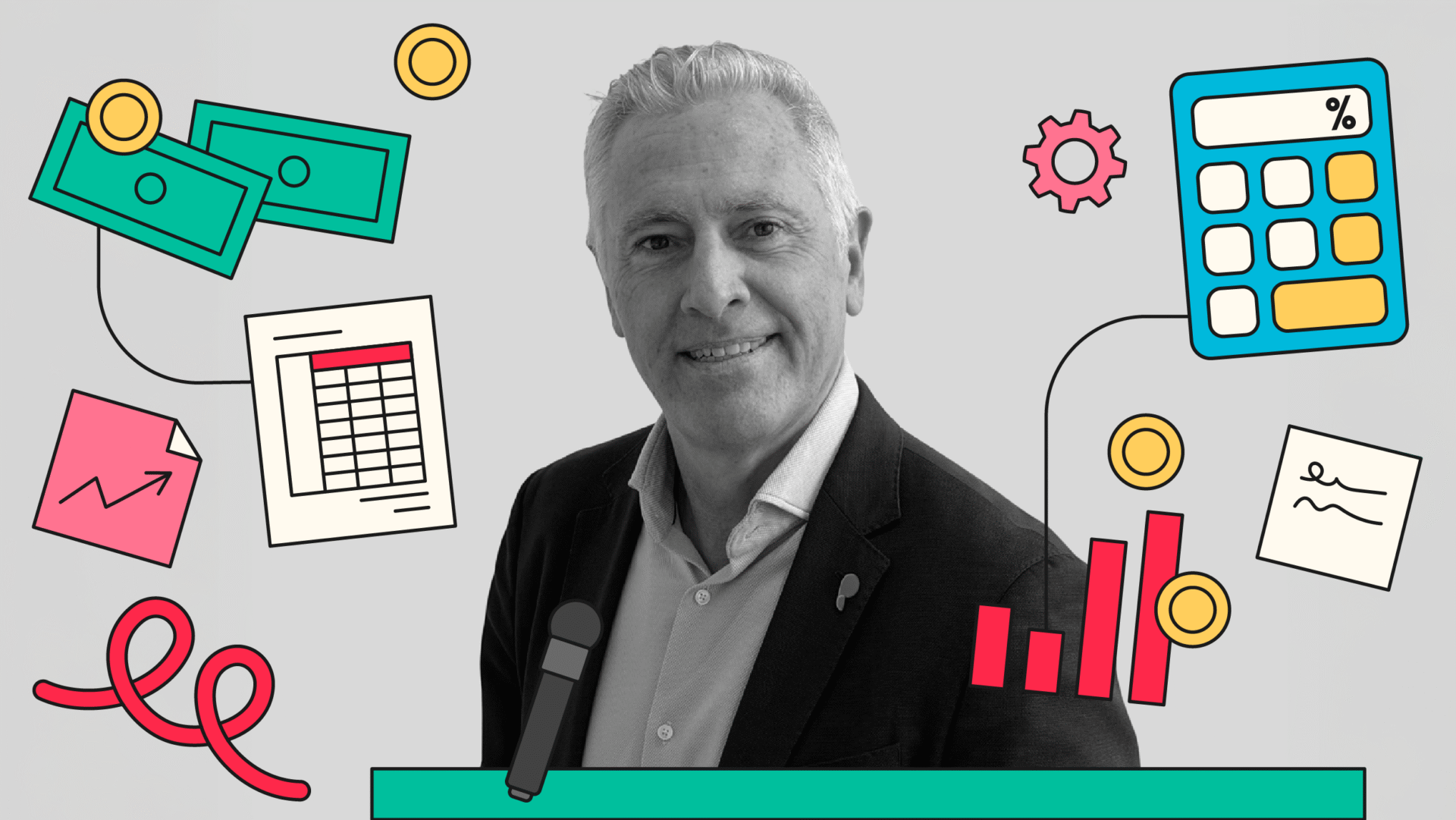
After more than 30 years in finance and leadership roles across manufacturing, advanced materials, and pharmaceuticals, Steve McCue joined Pragmatic Semiconductor in 2025 as the company entered a new phase of growth.
Pragmatic Semiconductor develops ultra-thin, flexible chips that can be embedded into everyday products, from food packaging and clothing labels to healthcare wearables. As the business transitions from years of research and development into commercial manufacturing, McCue’s role extends well beyond finance. Alongside leading the finance function, he oversees corporate services including IT, legal, supply chain and planning, helping build the financial and operational framework needed to support commercial scale.
Drawing on more than two decades as a CFO, McCue shares how financial leadership changes as deeptech companies mature, why scenario planning is essential in capital-intensive industries and the lessons he believes every aspiring CFO should learn beyond finance.
Can you tell me a little about yourself, Pragmatic Semiconductor and your role there?
I joined Pragmatic about 13 months ago. Before that, I’d worked across several different industries, but semiconductors were completely new to me. What attracted me was the opportunity to join a UK-based company with innovative technology that is approaching semiconductor manufacturing differently.
Pragmatic enables the Internet of Things by producing flexible chips that are lower cost than traditional silicon, require less energy and fewer harmful chemicals to manufacture and can be produced with significantly lower capital investment. It’s a complex business, but it’s exciting because we’re developing technology that changes where semiconductors can be used.
I’ve been a CFO for around 25 years, although I didn’t follow the traditional finance-only route. Early in my career I worked for BP before joining JM Huber, where I gained experience in high-volume electronics manufacturing. Through a leadership development program, I moved into general management, running manufacturing operations in Scotland and later Singapore before returning to Europe in CFO roles across Finland, the Netherlands and France. That broader operational experience continues to shape how I approach the CFO role today.
What changes financially when a deeptech business moves from the research and development stage into commercial production?
That’s exactly the transition we’re going through today. Although we’re now commercializing our products and increasing production, we’ve spent 15 years developing the technology.
One of the biggest challenges is capital allocation. We need to continue investing in future generations of products while also managing day-to-day cash and supporting commercial growth. We currently have a Gen 3 product in the market, with Gen 4 launching this year and Gen 5 planned for next year, so balancing today’s priorities with tomorrow’s opportunities is critical.
The organization also changes. The key performance indicators that matter in an R&D-focused business are very different from those in a commercial manufacturing company. You have to help people transition from technical milestones to commercial performance while continuing to invest in future innovation.
What are the biggest mistakes a hardware or deeptech company can make if it tries to scale too quickly?
The most important thing is understanding your market and having strong customer relationships before you scale.
We’re fortunate to have global customers who are strong supporters of what we’re doing. We’re working closely with them and their end customers, which gives us confidence that demand exists before we invest further.
As we grow, we’ll also need to think about manufacturing resilience. Today we manufacture in one location in the UK, but over time we’ll need additional production capability in other parts of the world to provide greater resilience in our supply chain.
One advantage of our technology is that building a flexible semiconductor manufacturing line requires significantly less capital than a traditional silicon fabrication plant, making future expansion more achievable.
How does the role of the CFO evolve once a company moves from innovation into revenue generation?
Financial planning and analysis becomes even more important.
You need the ability to model different scenarios and have a Plan A, Plan B and Plan C. Strong business partnering through FP&A is critical because you’re helping the organization move from an R&D mindset into commercial manufacturing.
The measures of success also change. Instead of focusing on research milestones, you’re looking at cycle time, throughput, yield and delivering customer commitments. Planning becomes closely connected with supply chain, manufacturing and cash flow visibility, so having those functions working together is essential.
Are there financial signals you look for to determine whether a company is ready to commercialize?
For me, it’s about understanding the market and having deep relationships with strategic customers.
It’s much easier when customers are actively pulling your products into the market rather than you pushing them. As you’re scaling, having a small number of strategic customers who understand your technology and are aligned with your priorities gives you a much stronger foundation.
Without that alignment, you’re constantly competing with other priorities inside your customers’ organizations, making commercial growth much more difficult.
Is it different to scale a hardware company compared to a software company?
I think it’s harder to scale a hardware company because you’re making significant capital investment decisions well before you generate the revenue.
For us, some manufacturing equipment has lead times of around 15 months, so you’re making investment decisions long before the assets are installed. That requires confidence in both the market opportunity and your customer demand.
Manufacturing also brings additional complexity. You’re managing physical assets on the balance sheet, producing products that need to be shipped globally and complying with different standards in different countries. There are simply many more moving parts than there are in a software business.
What advice would you give someone hoping to become a CFO?
I’d encourage people to build broader business experience wherever they can.
Looking back at my own career, running manufacturing operations and having direct P&L responsibility taught me lessons I still rely on today. Finance professionals often understand a profit and loss statement, but they aren’t always responsible for delivering it. Having that operational accountability gives you a different perspective.
I’d also recommend finding great mentors and executive coaches. I’ve benefited from coaching at several points in my career, particularly when moving from finance into general management and then into broader leadership roles. Those experiences helped me understand my own strengths and become a more effective leader.
Finally, I think curiosity is important. A CFO needs an inquisitive mind, resilience and the confidence to make difficult decisions. You’re not always going to be the most popular person in the room, so you need to be comfortable making tough calls when they’re necessary.
What do you do outside work to prevent burnout?
I enjoy road cycling and have always enjoyed endurance sports.
On the weekends I like getting out for a long ride, either on my own or with friends. It’s a great way to clear my mind while staying active.
I’m also a season ticket holder at Leicester Tigers, so I enjoy watching rugby as well as participating in sports myself.
What inspires you?
My family inspires me the most.
My wife and I have two children who are now building their own careers. My son is currently living in Australia, and my daughter lives nearby. Watching them develop, find their own paths and experience different opportunities is incredibly rewarding.
I hope I can be a good example for them, but they also inspire me every day as I watch them build their own futures.
After more than 30 years in finance and leadership roles across manufacturing, advanced materials, and pharmaceuticals, Steve McCue joined Pragmatic Semiconductor in 2025 as the company entered a new phase of growth.
Pragmatic Semiconductor develops ultra-thin, flexible chips that can be embedded into everyday products, from food packaging and clothing labels to healthcare wearables. As the business transitions from years of research and development into commercial manufacturing, McCue's role extends well beyond finance. Alongside leading the finance function, he oversees corporate services including IT, legal, supply chain and planning, helping build the financial and operational framework needed to support commercial scale.
Drawing on more than two decades as a CFO, McCue shares how financial leadership changes as deeptech companies mature, why scenario planning is essential in capital-intensive industries and the lessons he believes every aspiring CFO should learn beyond finance.