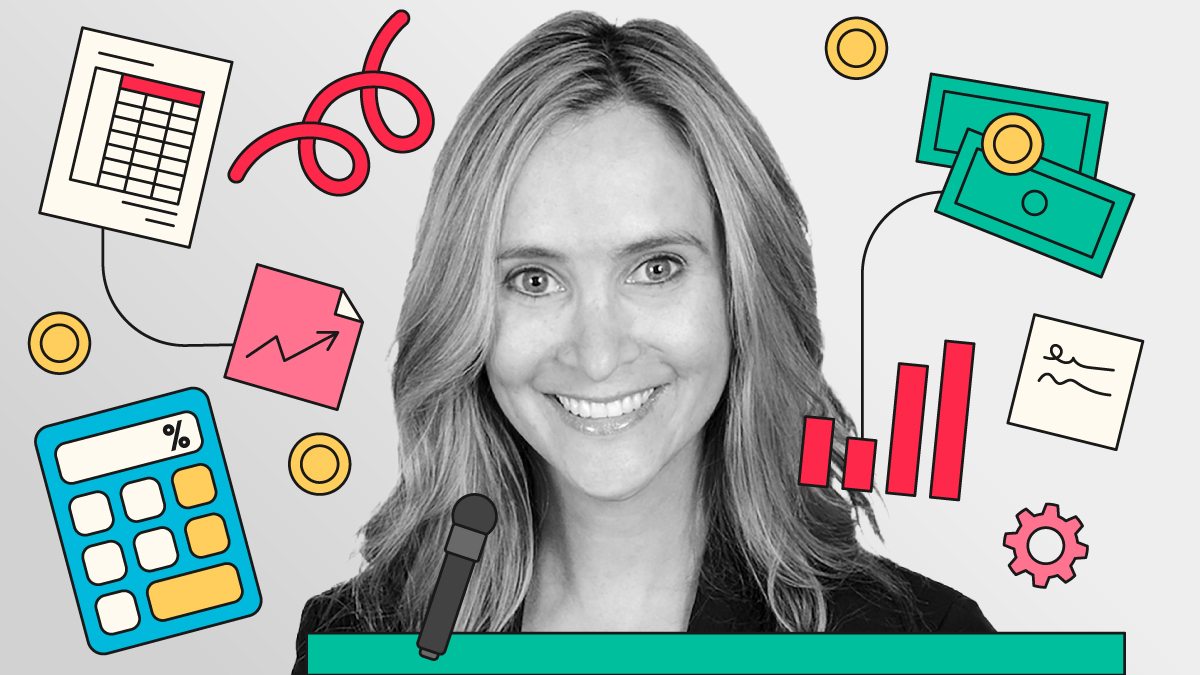
Samantha Greenberg joined AlphaSense after building a career that has spanned public and private market investing, company building, and financial leadership.
Before becoming a CFO, Greenberg spent 18 years as a technology investor, holding roles at Goldman Sachs and Paulson & Co. In 2016, she founded Margate Capital Management, which grew into the third-largest female-run hedge fund in the United States before being sold to Citadel.
Greenberg moved into the CFO role in 2021 and later served as CFO at ID.me and Mint House. She recently joined AlphaSense, an AI-powered market intelligence platform she had already used extensively as both an investor and finance leader.
During our conversation, Greenberg discussed AlphaSense’s recent $350 million funding round, the changing role of the modern CFO, and why real-time data is becoming essential to financial decision-making. She also shared the importance of productive debate, her favorite leadership books, and the career she would pursue if she were not a CFO.
Tell me about your journey to becoming a CFO and why you joined AlphaSense
I spent 18 years as a technology investor across public and private markets. I worked at large firms, including Goldman Sachs, and spent seven years at Paulson & Co. In 2016, I started my own hedge fund, which ultimately became the third-largest female-run fund in the country and was sold to Citadel.
While running that business, I realized that I loved being an operator even more than I loved being an investor. As an operator, you can analyze data, see the effect of your decisions, and help drive value creation. As an investor, you are always on the outside looking in.
After selling my company and spending a couple of years at Citadel, I became a CFO in 2021. My time at Citadel gave me a deep appreciation for the intersection of data science and fundamental forecasting.
I joined AlphaSense because I had been a power user of the platform for years. Research projects that previously took my finance teams days, including analyzing competitors, pricing, market entry, and value propositions, could be completed in about an hour using AlphaSense.
I understood the value of the product firsthand. AlphaSense also has significant business momentum, and the shift toward always-on markets makes this the right moment for always-on intelligence.
AlphaSense recently raised $350 million at a $7.5 billion valuation. Why was this the right time to raise capital?
We raised $350 million at a $7.5 billion valuation, nearly double the valuation from our previous round. We also announced that AlphaSense surpassed $600 million in annual recurring revenue during the first quarter, implying growth of well over 40% year over year.
As part of the funding round, we announced a strategic partnership with Accenture, which is also a longtime AlphaSense customer and became one of the lead investors in the round. Together, we are bringing AlphaSense’s AI market intelligence and workflow automation to Accenture’s enterprise transformation clients.
We are seeing accelerated growth at scale, and that extends beyond revenue. Token consumption on the platform is growing 25 times year over year, with run-rate consumption reaching 20 trillion tokens.
We are also expanding internationally. International business already represents 21% of our annual recurring revenue and is growing rapidly.
The capital allows us to accelerate our product roadmap and continue expanding internationally. We are grateful that the momentum of the business and the impact of the platform have been recognized by top institutional investors.
How would you define a modern CFO, and what skills or traits does a modern finance leader need?
Many of the skills developed through investing are highly relevant to the modern CFO.
Investing is about surfacing insights quickly, separating signal from noise, and allocating capital effectively. Those are also some of the most valuable capabilities a CFO can bring to a rapidly scaling company.
CFOs help leadership teams decide how to prioritize product and engineering roadmaps, measure the return on spending, balance growth with profitability, and determine whether to build or buy parts of a platform.
Rigorous debate is also important. Companies are operating in an environment of significant uncertainty, particularly around AI.
Software business models are also shifting from relatively simple seat-based pricing toward consumption and outcome-based models. That creates additional forecasting complexity because companies must anticipate how customers will use a product.
Modern forecasting should combine data science with strong business fundamentals.
What excites you most about your current role?
I think of the CFO’s role as having three main responsibilities.
The first is surfacing real-time, actionable insights that can drive revenue and profits. The second is being a true cross-functional partner to product, engineering, and go-to-market teams on capital allocation and problem-solving.
The third is serving as the sales and customer success function for the investor community.
Together, those responsibilities allow the CFO to help create shareholder value while becoming a force multiplier for the company’s innovation and productivity.
What excites me is the opportunity to improve how we surface real-time insights and strengthen the frameworks we use to allocate our time and capital.
What are your top two priorities for the year ahead?
My first priority is transforming forecasting so that we can surface insights that drive revenue and profits in real time.
Finance should not only look back at what happened. We need to understand what is happening now, determine whether action is required, and use that information to improve decision-making.
My second priority is becoming an even stronger cross-functional partner in determining how we use our time and resources.
We need to consider how much time we spend on truly disruptive initiatives compared with work that sustains the business and keeps us competitive.
Is AI something to fear or something to embrace?
I should acknowledge that I am not a neutral observer. I am the CFO of an AI-native market intelligence and workflow automation platform, and I serve on the AI board at the Wharton School.
I believe AI should be embraced. It is the most powerful productivity tool of our time and represents a step change in what a person, team, or company can accomplish.
It is also one of the reasons I joined AlphaSense. The platform can turn projects that previously took my finance team days into work that can be completed in about an hour.
Like any tool, AI should be used safely and responsibly. However, the companies and leaders that thrive will be those that use it to develop products faster, enter new markets, surface valuable insights, and make higher-impact decisions.
What is the best piece of business advice you have received?
One of the most important lessons I have learned is that leaders need to encourage vigorous debate.
As humans, we often shy away from conflict, disagreement, and difficult conversations. Leaders need to create enough psychological safety for every consideration and point of view to be raised.
I encourage my teams to debate issues openly, including having different levels of the organization in the same room. That is how we identify the best answer.
Once the decision has been made, I believe in the idea of disagreeing and committing. Everyone needs to come together and support the final course of action.
What books do you think every finance leader should read?
Two books I keep on my desk and return to repeatedly are Difficult Conversations and Connect.
Leading a high-performing team, particularly in a knowledge-based technology business, requires more than attracting talented people. Leaders must also motivate, develop, and retain them.
Employees know when a manager is committed to their development. Meaningful mentorship requires celebrating growth when things go well, but it also requires giving people the feedback they need to improve.
Many leaders shy away from those conversations because conflict can be uncomfortable. These books help leaders handle difficult discussions, build stronger workplace relationships, and help their teams grow.
What do you do outside of work to protect yourself from burnout?
One of my favorite Stanford Business School professors told our class that work should be more fun than fun. That is genuinely true for me because I love the CFO role and how cross-functional it is.
Outside of work, I love spending time outdoors. That might mean hiking in the mountains, walking on the beach, or simply being silly and singing karaoke with my friends.
If you were not a CFO, what would you like to do?
My other dream job would be serving as the general manager of a professional sports team.
I have always been passionate about sports, but the general manager role has also been transformed over the past several decades. Today’s best general managers understand behavioral economics, sports psychology, data science, and statistics.
They must also manage extraordinarily talented and complex people while building a strong culture, much like the CFO of a technology company.
I would particularly love to work in women’s sports because it feels like the industry has reached a generational turning point, with more capital, fandom, and viewership entering the business.
What is currently inspiring you, and why?
I am fascinated by self-improvement and behavioral science. Some of my favorite books include Angela Duckworth’s Grit, Katie Milkman’s How to Change, and James Clear’s Atomic Habits. I also listen to several behavioral science podcasts.
One idea that is particularly relevant to me right now is the “fresh start effect” discussed in How to Change. People are measurably more motivated to change and improve during clean-slate moments, such as the beginning of a new year, a birthday, or the start of a new job.
I joined AlphaSense two months ago, so I am trying to be intentional about using that fresh-start energy. I want to apply it not only to my own work but also to improving performance across the finance organization.
Samantha Greenberg joined AlphaSense after building a career that has spanned public and private market investing, company building, and financial leadership.
Before becoming a CFO, Greenberg spent 18 years as a technology investor, holding roles at Goldman Sachs and Paulson & Co. In 2016, she founded Margate Capital Management, which grew into the third-largest female-run hedge fund in the United States before being sold to Citadel.
Greenberg moved into the CFO role in 2021 and later served as CFO at ID.me and Mint House. She recently joined AlphaSense, an AI-powered market intelligence platform she had already used extensively as both an investor and finance leader.
During our conversation, Greenberg discussed AlphaSense’s recent $350 million funding round, the changing role of the modern CFO, and why real-time data is becoming essential to financial decision-making. She also shared the importance of productive debate, her favorite leadership books, and the career she would pursue if she were not a CFO.