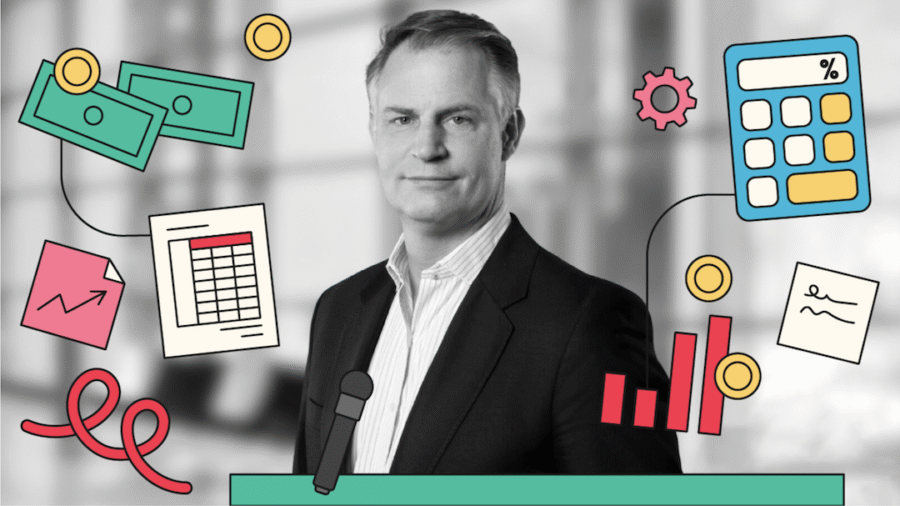
Martin Edstrom is Chief Financial Officer of Paragon, a global business services company that provides outsourcing solutions to help organisations grow and operate more efficiently. The company works with large global brands and financial institutions to support marketing services and customer communications.
Edstrom brings more than two decades of experience in corporate finance, strategy, and investment banking. Before joining Paragon, he led the corporate finance function at Royal Mail Group and previously spent nine years in investment banking at Goldman Sachs.
In this conversation, he reflects on his journey into finance leadership, the evolving responsibilities of CFOs, and the opportunities that technology may create for the industry.
How did you become a CFO?
My journey to CFO was probably not the traditional one. I didn’t come through the accounting or auditing route.
I started my career in investment management, working for a large Scandinavian pension company as an analyst and portfolio manager. After that, I went into investment banking and spent a number of years in London with Goldman Sachs.
Following banking, I joined Royal Mail, where I worked in corporate finance. I spent around eight years there and was responsible for corporate finance across the group. At that point, I was ready to take the next step, and Paragon was looking for someone with strong corporate finance experience to help support growth through acquisitions and capital markets decisions. That is how I came into the CFO role here.
What skills or traits does a good CFO need?
I think a good CFO needs to be an all-rounder.
Of course, you need to look after the numbers and ensure the financial results are delivered and communicated properly. But you also need to be involved in strategy and understand where the business is going.
You need to lead people and communicate well across the organisation. Even if people do not report directly to you, many employees will listen to what you say and how you say it.
On top of that, CFOs today need to understand areas like technology and how the landscape is changing. It is a very broad role that requires knowledge across many topics.
What excites you most about your current role?
There is a lot of exciting change happening in our industry.
In the business services space, artificial intelligence is something everyone is talking about. We are exploring how AI can help us deliver services more efficiently and help our customers improve how they operate.
Technology has always been an important part of what we do. We often describe our services as technology-enabled services. The development of AI creates another layer of opportunity on top of that.
The full impact of AI will take time to develop, especially as many of our clients operate in regulated industries. But we see a lot of potential.
What is the best bit of business advice you’ve ever received?
One thing I learned early in my career from a senior banker at Goldman Sachs was to always ask the most junior person in the room what they think.
That approach does two things. First, it makes everyone feel included in the discussion. Second, it ensures everyone is prepared and thinking about the broader questions rather than just their individual tasks.
I have found that it works very well for building strong teams and encouraging people to engage with the bigger picture.
For me, it is the regulatory and audit burden.
Over the years, the regulatory environment has become more demanding, which is understandable, but it does take up a significant amount of time.
Simplifying compliance processes, without reducing the necessary oversight, would free up time to focus more on growth and efficiency.
What’s the biggest challenge facing your sector at the moment?
There are always challenges somewhere within the business.
At Paragon, we are a very acquisitive organization, and we operate in a decentralised structure. That means we are constantly integrating new businesses and systems.
Bringing the organisation together from a systems and operational perspective is an ongoing challenge. It is not something new, but it is a constant focus for us.
At the same time, we have a very stable customer base and a resilient business model. In many ways, the biggest challenge is making sure we can fully capture the opportunities that new technologies like AI might create.
What single thing do you think would make your job easier?
If we could get all our finance operations on one platform, that would make life much easier.
In most companies, there is always some level of change happening. New businesses join the organisation, and they’re not always on the same operating system.
That creates questions and complexity when trying to understand the numbers across the group. Having everything on a single platform would simplify things.
What’s been your proudest achievement in your current role?
We recently completed a full refinancing of Paragon.
The transaction involved around €685 million of new financing and sets the business up for the next four or five years as we execute our strategy.
It has been a long process involving many people across the organisation, and it is satisfying to see it completed. It gives us a strong foundation for the next phase of growth.
If you weren’t a CFO, what would you like to do?
If I did not need to think about the financial side of things, I would probably enjoy being a sports coach.
I find the idea of building a team and helping people perform together very interesting. In sport, you test yourself against competitors every week, and the results are very clear.
That challenge would be very appealing.
What do you do outside of work to protect yourself from burnout?
Earlier in my career, especially during my investment banking years, the job could easily become seven days a week. I have learned that it is important to step away from work when possible.
These days I try to spend time with my family and take long walks with the dog on weekends. Getting outside and clearing your mind makes a big difference.
Which book do you think every finance leader should read at least once?
A book I would recommend is Factfulness by Hans Rosling.
It uses data and statistics to show that the world is actually improving in many ways, even though the news often suggests otherwise. The book looks at trends such as life expectancy, literacy, and poverty and shows how these have improved over time.
It is a very positive and uplifting book that encourages people to look at facts and data before forming conclusions.
What is currently inspiring you today and why?
I would say the book Factfulness again. It reminds you that the world is often in a better place than we think when you look at the data.
It is inspiring because it shows how much progress has been made globally and encourages a more positive and fact-based perspective.
Martin Edstrom is Chief Financial Officer of Paragon, a global business services company that provides outsourcing solutions to help organisations grow and operate more efficiently. The company works with large global brands and financial institutions to support marketing services and customer communications.
Edstrom brings more than two decades of experience in corporate finance, strategy, and investment banking. Before joining Paragon, he led the corporate finance function at Royal Mail Group and previously spent nine years in investment banking at Goldman Sachs.
In this conversation, he reflects on his journey into finance leadership, the evolving responsibilities of CFOs, and the opportunities that technology may create for the industry.
For me, it is the regulatory and audit burden.