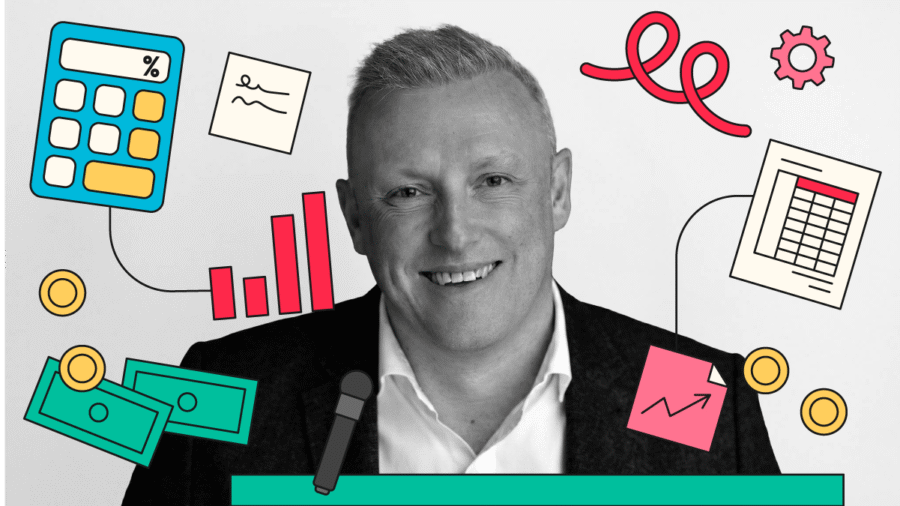
Joe Fitzgerald’s career has been shaped almost entirely within one business. He joined Domestic & General more than two decades ago as a trainee accountant and has grown alongside the company as it expanded, broke through international borders, and scaled into a global appliance care specialist. Over the years, he has worked across finance, underwriting, data analytics, and customer-facing leadership roles, gaining a broad view of how the business operates beyond the numbers.
Today, as CFO, Joe plays a central role in guiding Domestic & General’s strategy as it continues to grow internationally. The company now operates in 12 markets across the UK, Europe, and the US, employs more than 4,000 people, protects over 22 million appliances, and serves more than 6.7 million subscription customers. With annual revenues reaching £1.2 billion, Domestic & General is focused on deepening its presence in existing markets while expanding into new ones.
Here, Joe reflects on his journey to becoming a CFO, the skills that matter most in finance leadership, and what keeps him motivated both inside and outside the business.
How did you become a CFO?
My journey is really at this company. I joined Domestic & General as a trainee accountant and followed a fairly conventional finance path at the start. I trained and qualified, but after about five years I actually left the finance team.
I moved into the trading areas of the business, looking after underwriting, and then into data analytics. I was always working with numbers, but in roles that were much closer to the customer. That eventually led to a managing director role, where I was responsible for areas like marketing, digital, data and analytics, pricing, and underwriting.
When our current CEO Matthew joined the business, he offered me the opportunity to become CFO. I was delighted, because the role gives you the chance to be involved across the whole business and to help shape its overall strategy. I’ve really enjoyed it since taking it on.
What skills or traits does a good CFO need?
You need a broad set of skills. Being technically strong and comfortable working with numbers is essential, but those are really just entry requirements.
What I look for in finance professionals is commercial thinking and the ability to work closely with the business. Business partnering is a big part of finance. You also need to be adaptable, resilient, and energetic, because no two days are the same and there is always something new happening.
Finance has to mirror what is going on in the business, and that means being able to respond quickly and work well with others.
What excites you most about your current role?
Domestic & General is a growth business, and that makes the role exciting. Growth brings opportunity, but it also brings challenges because the organisation has to keep evolving to support higher levels of activity.
The US expansion is a great example. We opened a small office in Chicago four years ago, and we now have around 150 employees in the US. We have just reached breakeven there and are moving into profitability.
Building what are effectively new businesses in new countries is something I really enjoy. Growth across all markets is exciting, but there is something particularly rewarding about establishing and scaling operations internationally.
What’s the biggest challenge facing your sector at the moment?
There isn’t one challenge that is specific to our sector. The bigger issue is the broader economic environment.
Consumer sentiment is fairly low across many of the markets we operate in, and that varies by territory. Inflation has had an impact, and although that is starting to ease in some places, economic confidence is still subdued.
A stronger economic environment would benefit all businesses, including ours.
What single thing would make your job easier?
For finance, it comes down to distillation and analytics. We are investing heavily in data and AI because we want to make information easier to access and easier to understand.
The idea of having tools that can summarise complex data and answer questions quickly is incredibly powerful. It would reduce the need for people to chase numbers and allow teams to focus more on decision-making.
AI has the potential to do for data what spreadsheets did decades ago, making information richer, faster, and more accessible.
What is the best bit of business advice you’ve ever received?
Business is all about people, and people follow leaders they trust.
I always ask myself whether my team trusts me. Do they trust me to support them when things go wrong? Do they trust me to reward them when things go well? Do they trust me to look after their careers and treat them fairly?
The same applies to colleagues, partners, and customers. If you build trust and consistently do what you say you will do, you give yourself the best chance of succeeding in business.
Which book do you think every finance leader should read at least once?
It’s not a finance book, but The Pyramid Principle by Barbara Minto.
It focuses on how to structure ideas and communicate them clearly, particularly in presentations and business cases. It genuinely changed how I approach presentations and how I put ideas across, whether I am discussing strategy, making a business case, or explaining a decision.
What do you do outside of work to protect yourself from burnout?
I spend a lot of time with my family and help look after my son’s football teams. That keeps me busy and grounded.
I am also quite disciplined about taking proper holidays. It is very easy to take time off but still stay connected to work. I try to genuinely switch off so I can recharge, which ultimately benefits both me and the business.
What’s been your proudest achievement in your current role?
Our expansion into the US is something I am very proud of. Entering the US market is challenging and many businesses struggle to make it work, but we have made strong progress and have also completed two acquisitions there.
Another proud moment was leading a major replatforming of our EU operations after Brexit. It was a complex project that had to be delivered quickly, and the team did an excellent job.
Both experiences reinforced the importance of teamwork and execution during periods of significant change.
If you weren’t a CFO, what would you like to do?
I see myself as a business person as much as a finance professional. If I were not a CFO, I would want to be in a customer-facing business role, driving revenue and results.
I enjoy being in roles where you can see tangible outcomes and understand the direct impact of your work.
What is currently inspiring you today and why?
I have been listening to a podcast called In Good Company, hosted by Nicolai Tangen. He interviews senior leaders and investors, and the conversations are very open and insightful.
I enjoy learning from different perspectives, and I find that listening to how others think and operate always gives me something new to reflect on and apply in my own work.
Joe Fitzgerald’s career has been shaped almost entirely within one business. He joined Domestic & General more than two decades ago as a trainee accountant and has grown alongside the company as it expanded, broke through international borders, and scaled into a global appliance care specialist. Over the years, he has worked across finance, underwriting, data analytics, and customer-facing leadership roles, gaining a broad view of how the business operates beyond the numbers.
Today, as CFO, Joe plays a central role in guiding Domestic & General’s strategy as it continues to grow internationally. The company now operates in 12 markets across the UK, Europe, and the US, employs more than 4,000 people, protects over 22 million appliances, and serves more than 6.7 million subscription customers. With annual revenues reaching £1.2 billion, Domestic & General is focused on deepening its presence in existing markets while expanding into new ones.
Here, Joe reflects on his journey to becoming a CFO, the skills that matter most in finance leadership, and what keeps him motivated both inside and outside the business.