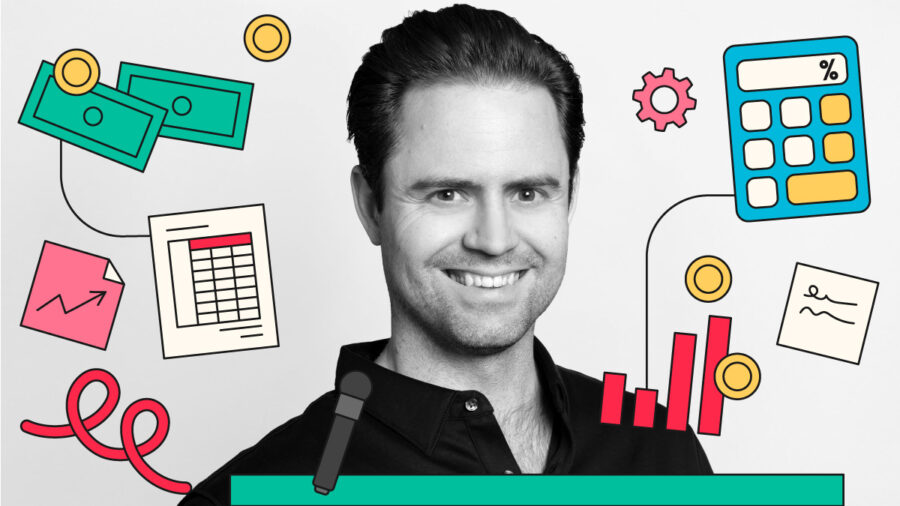
Fredrik Iversen is the CFO of Aonic, a global technology and gaming group focused on user acquisition platforms and game development. He joined the company in its early stages and has been part of its rapid growth, both organically and through acquisitions.
Before Aonic, he worked across treasury, business control, consulting, and finance roles, including positions at Stillfront Group, Nordea, and Chrono Capital. His background combines entrepreneurial experience with corporate finance, shaped by his studies in Corporate Finance and Investment Management at the Stockholm School of Economics.
At Aonic, he works across a fast growing and global business, supporting expansion across Europe and North America while navigating a dynamic and evolving technology landscape.
How did you become a CFO?
I think it started with deciding to study finance. I did my master’s in finance at the Stockholm School of Economics, which is also when I moved from Norway to Sweden.
At the time, I had a strong interest in investing and founded an investment company focused on option strategies. We ran that for several years without any loss making years, but when the macro environment shifted and increased the risk profile, we decided to return capital to investors before that risk materialized.
After that, I focused on my consulting business for about five years, working with banks and early stage companies. That gave me broad exposure to different roles, environments, and problem sets.
The real turning point came when I decided to take on a more traditional role with the intention of learning core finance disciplines. I took a pay cut to do that, but it allowed me to build a strong foundation. A few years later, the opportunity to step into a CFO role came up, and that conscious decision to move in that direction played out well.
What skills or traits does a good finance leader need?
I think it comes down to sound judgment and decision making, and the ability to anticipate what lies ahead.
That often requires more technical competence than people might assume, although a strong team can support that. You also need grit and the ability to stay calm under pressure.
A big part of the role is identifying risks early and steering clear of them. In many cases where teams run into problems, it is because those risks were not identified early enough.
In finance, it is often about buying time. The earlier you anticipate something, the more time you have to act.
What excites you most about your current role?
We operate in a fast growing technology space, and it feels like we are in the next phase of that growth, both as a company and as a market.
That makes it a very exciting and defining time. There is a lot happening, and the pace of development means there is always something new to learn or build.
What’s the biggest challenge facing your sector at the moment?
The biggest challenge is also what makes it exciting, which is the speed.
We are in a fast moving environment with strong opportunities, and success often comes down to speed of execution. At the same time, the broader world is also moving faster, especially with developments in AI.
For finance, the challenge is building a function that can support the business while keeping up with that speed.
What single thing do you think would make your job easier?
Time is probably the scarcest resource.
If there were more hours in the day, that would make a big difference.
What is the best bit of business advice you’ve ever received?
I would say it is to optimize for learning rather than salary, especially early in your career.
One of the best decisions I made was taking a significant short term pay cut to move into a role where I could learn more. I saw that as an investment, and it paid off.
What you earn in a year or two is less important than building long term capabilities and earning potential.
Which book do you think every finance leader should read at least once?
Rather than a traditional finance book, I would point to books on personality and behavioral frameworks.
Finance leaders spend a lot of time processing information, influencing decisions, and working with people. Understanding how people think and communicate is very valuable.
I have been reading a book called My True Type, which looks at personality frameworks.
What do you do outside of work to protect yourself from burnout?
I try to work out and disconnect from work when I can, whether that is through games, movies, or other activities like working out.
Family time is very important to me, and the time I spend with them helps me switch off.
I also value having time to pause and reflect, especially when things are busy.
What’s been your proudest achievement in your current role?
I would say building the group at Aonic and being part of that journey from the beginning.
There have been many moments along the way, but overall, being part of building the company together with the team is what stands out most.
If you weren’t a CFO, what would you like to do?
Probably something more entrepreneurial or investment related.
I could see myself going back to something in that space.
What is currently inspiring you today and why?
Right now, I find personality theory very interesting. It has been something I have spent a lot of time on this year, and it has been quite eye opening.
More generally, I find that inspiration comes from stepping away from day to day work and allowing time for rest and reflection.
Fredrik Iversen is the CFO of Aonic, a global technology and gaming group focused on user acquisition platforms and game development. He joined the company in its early stages and has been part of its rapid growth, both organically and through acquisitions.
Before Aonic, he worked across treasury, business control, consulting, and finance roles, including positions at Stillfront Group, Nordea, and Chrono Capital. His background combines entrepreneurial experience with corporate finance, shaped by his studies in Corporate Finance and Investment Management at the Stockholm School of Economics.
At Aonic, he works across a fast growing and global business, supporting expansion across Europe and North America while navigating a dynamic and evolving technology landscape.