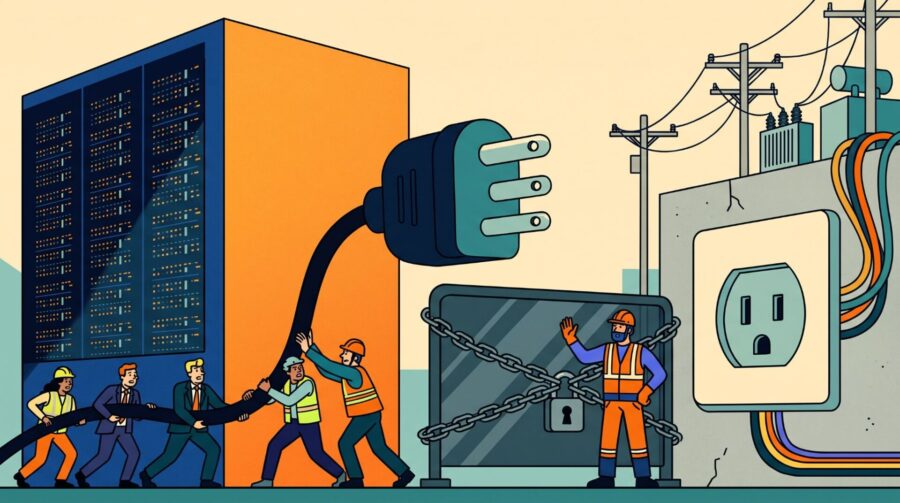
In what’s becoming a recurring theme, an American Big Tech firm makes a song and dance about investing in a UK data centre — accompanied by much fanfare from His Majesty’s Government — and then backtracks later. First it was OpenAI excusing itself from the Stargate UK project in April, citing high energy costs and ‘regulatory uncertainty.’ And now, it’s Microsoft abandoning a residency commitment at a planned Nscale data centre, mostly because a connection to the UK’s energy grid couldn’t be secured for the site until 2030.
Given that ‘sovereign’ AI has become a priority for the UK, much as it has elsewhere in Europe, the disruption of these plans bodes poorly for the country’s future. But while industry experts accept that Britain’s data centre pipeline could witness further withdrawals, they affirm that demand for compute capacity in the UK remains high overall. By extension, a company may cancel its plans in one area simply because it prefers to invest in a project in another, perhaps where a grid connection is more readily available.
Yet grid connections will be readily available only if the UK government invests more in the country’s energy infrastructure, something which could take years to bear fruit. In the meantime, it has announced plans to prioritise connections for critical data centres, while energy regulator Ofgem is working to remove ‘speculative’ projects from the grid connection pipeline.
Lots of demand, but less supply
What’s significant about Microsoft’s withdrawal from the Nscale data centre in Loughton, Essex, is that Nscale attempted to secure alternative sources of energy, after it became apparent that a grid connection wouldn’t materialise in time for the planned opening in Q1 2027. The facility was pencilled to generate 50MW in compute capacity, with a maximum of 90MW, yet the failure to guarantee an alternative energy source underlines how reliant UK-based providers are on the National Grid.
Despite last month’s withdrawal, Microsoft has reaffirmed its commitment to its partnership with Nscale, as well as to its planned $30bn investment in the UK, including $15bn earmarked for building out the country’s cloud and AI infrastructure. Nscale has said something very similar, explaining that Loughton’s problems don’t affect any of its other planned facilities.
“We remain committed to both the Loughton project and the UK, and we are exploring alternative power sources for the site in addition to other expansion sites in the UK,” a spokesperson for the company said. “Our relationship with Microsoft remains strong and long-term, and this unfortunate London-wide grid issue has no impact on our other contracts.”
Industry experts agree that isolated withdrawals don’t prove a lack of demand for AI-ready data centres in the UK. In fact, Analysys Mason partner Richard Morgan says demand for data centre capacity is “strong and growing” in Britain.
“[Capacity] has grown by around 12% a year over the past three years, to around 1.8GW, and AI is driving demand for even faster growth,” he says. “We would not read these recent withdrawals as a sign that UK demand is falling away.”
The issue is on the supply side, according to Morgan. There’s a very large pipeline of proposed projects competing for available energy, with Ofgem’s most recent figures indicating 73GW of data centre demand in the connection queue, which is about 40 times the UK’s current live data centre capacity.
Because the queue is now so long, potential tenants (such as Microsoft and OpenAI) will select the projects that come online the fastest, and with the least risk. “A project that cannot get power until the 2030s will often lose out to one that can deliver in two to three years,” Morgan says.
‘Flaky’ grid connection timelines
Other experts agree. Matt Evans, the Director of Markets and COO at trade association techUK, says that time-sensitivity means investments will not wait in the face of delays.
“Flaky grid connection timelines are now deciding where Britain’s compute infrastructure gets built, and for a sector that already supports 43,500 jobs and £4.7bn in GVA a year, that should worry everyone,” he says. “The Energy Secretary should be prioritising how we give the sector driving the UK’s growth the tools it needs to expand.”
Because capital tends to avoid risky ventures, we could witness additional data centre withdrawals in the not-too distant future. “There is a risk that we see more projects delayed, scaled back or moved elsewhere,” says Kate Hanaghan, Chief Research Officer and Partner at TechMarketView.
Hanaghan agrees that the UK has been successful in attracting commitments from some of the world’s biggest tech companies, yet she also highlights a difference between announcing plans and actually delivering on them.
“[Data centres] are highly capital-intensive projects, and investors need certainty over when they can become operational and what they will cost to run,” she says. “Where that certainty is lacking, investment will inevitably gravitate towards locations that can offer it.”
Energy is the ‘single biggest constraint’ on sovereign AI
Morgan also suspects that additional withdrawals could happen in the near future. But if they do, he argues they will “mostly reflect competition between projects” rather than a lack of underlying demand, with the projects that can secure power typically winning out.
This point aside, he also acknowledges that grid access is now “the single biggest constraint” on UK data centre growth, ahead of land, planning or access to capital. As noted above, the UK has a 73GW data centre connection queue, underlining the fact that simply moving from one area of the country to another may not always be possible.
“A lot of that queue will be speculative projects, but it shows that viable projects are stuck behind a large volume of requests that may never be built,” he explains. “This is most severe in London and the South East, which account for around 75% of current UK data centre capacity and where the network is most constrained.”
Upgrades to the electricity network take time and can face delays, yet the UK also faces another problem, which is the cost of energy. According to Morgan, larger energy users in the UK can pay “two to three times as much” for electricity as they would in the Nordics and similar markets.
“For an AI cluster, electricity is a major part of operating costs, and this makes the UK less attractive for large AI training data centres,” he explains. “As a result, UK demand is largely driven by workloads that need to be here, particularly latency-sensitive inference, where models need to run close to UK users, and use cases where data needs to stay within UK borders.”
At least 5 percent of national consumption
Despite the UK’s long grid queue, data centres already consume 5.9% of the UK’s energy supply, according to figures from the International Data Center Authority. This is substantially above the global average of 2%, and with the IDCA suggesting that “significant community and political pushback starts to occur” once data centres account for at least 5% of national consumption, you might be forgiven for wondering whether the UK can seriously ramp up its existing capacity.
“AI infrastructure investment is moving at a pace that the energy system is struggling to match,” says Hanaghan. Hence the “growing disconnect” between the UK’s AI ambitions and its ability to provide the necessary infrastructure, as evidenced by this year’s Microsoft and OpenAI withdrawals.
The UK government, for its part, is trying to rectify this situation. It has announced it will prioritise grid connections for strategically important data centres, although only if developers agree to a ‘covenant’ whereby they “invest in local communities, create local jobs and protect local water supplies.”
At the same time, energy regulator Ofgem said in July that it will disincentivise ‘speculative’ data centre projects by introducing a commitment fee. This may ultimately prevent further high-profile withdrawals, although Matt Evans argues that it must be complemented by the infrastructure that would make stronger commitment attractive.
“We back Ofgem’s work to clear speculative applications out of the queue,” he says, “but reform only counts if it gets ready projects connected sooner without dampening investment signals — that means reciprocal accountability and a proportionate commitment fee. Britain believing in itself again means building the infrastructure our ambitions depend on.”
In what’s becoming a recurring theme, an American Big Tech firm makes a song and dance about investing in a UK data centre — accompanied by much fanfare from His Majesty’s Government — and then backtracks later. First it was OpenAI excusing itself from the Stargate UK project in April, citing high energy costs and ‘regulatory uncertainty.’ And now, it’s Microsoft abandoning a residency commitment at a planned Nscale data centre, mostly because a connection to the UK’s energy grid couldn’t be secured for the site until 2030.
Given that ‘sovereign’ AI has become a priority for the UK, much as it has elsewhere in Europe, the disruption of these plans bodes poorly for the country’s future. But while industry experts accept that Britain’s data centre pipeline could witness further withdrawals, they affirm that demand for compute capacity in the UK remains high overall. By extension, a company may cancel its plans in one area simply because it prefers to invest in a project in another, perhaps where a grid connection is more readily available.
Yet grid connections will be readily available only if the UK government invests more in the country’s energy infrastructure, something which could take years to bear fruit. In the meantime, it has announced plans to prioritise connections for critical data centres, while energy regulator Ofgem is working to remove ‘speculative’ projects from the grid connection pipeline.
