
Sometimes a general-purpose technology is simply too general. A general-purpose AI model – such as those behind ChatGPT or Claude – may be perfectly capable, but that doesn’t mean it is the right tool for every job. For businesses with valuable knowledge of their own, or those looking to automate at scale, there comes a point when adapting the technology to the task can make more sense than adapting the task to the technology.
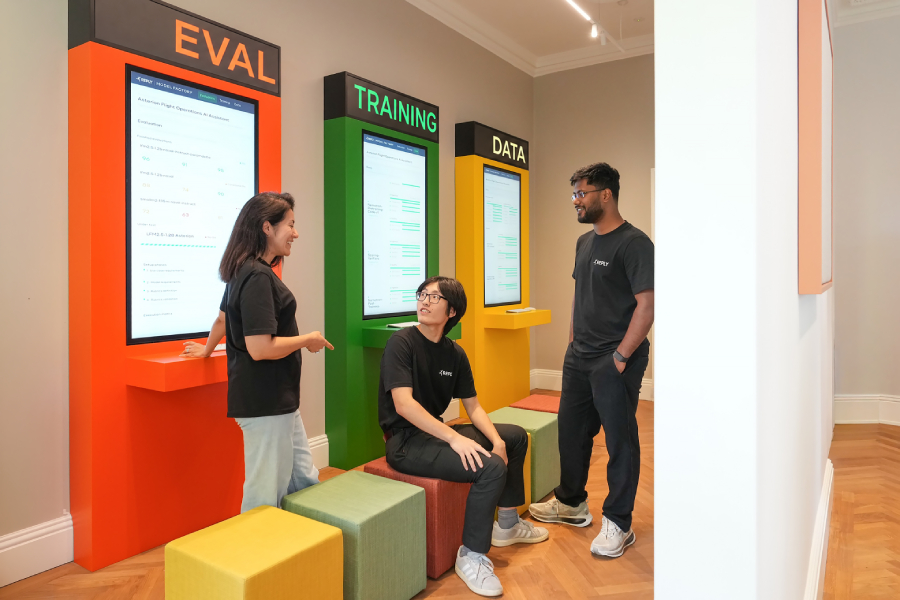
Reply is bringing that approach to central London through its House of Models, based at Reply House London, the Group’s new UK headquarters. Designed as the physical entry point to the Model Factory, it is where clients work alongside Reply engineers to turn their own data and expertise into specialised AI models. Reply also operates a House of Models in Turin, creating two dedicated environments where clients can work directly with Reply across the full lifecycle of AI models.
According to Daniele Vitali, the partner at Reply who is leading the Model Factory,
providing a physical space for the Model Factory helps clients and engineers work together to capture the knowledge a specialised generative AI model needs. “It is a mixture of taking the most valuable information that a customer has, mixing that with the intuition and expertise that a customer brings in, which is usually based on people … and cooperating with our engineers to turn that knowledge into models the organization can use at scale” he explains.
Choosing the right use case
Before any model is built, Reply first helps the client decide whether a specialised model is the right answer. At the House of Models, Reply runs workshops to give clients a baseline understanding of what a custom model can do, then examines their own business to establish where a model would create measurable business value and whether data exists to build it. Vitali stresses that specialised models are not the answer to every AI problem. The question is whether a company has knowledge, data, need for scale or sovereignty requirements that makes building one worthwhile. If it does not, he says, an existing model, supported by agents with access to company information, may be the better option.
Vitali says demand for the Model Factory will likely come from three main directions. The first relates to enterprises that boast “a wealth of data and IP and know-how,” which can be embedded in a model to build expertise or specialized capabilities in a particular domain.
A prime example of this is healthcare. “One of our clients has 20 years of experience treating a particular type of cancer, and has a body of specialist knowledge that is being captured in a model and will be offered to other clinics”. In that case, Vitali says, the model becomes a way to multiply the value of the organisation’s know-how. “The model creates opportunities for new revenue streams, giving the business a clear basis for calculating the return on its investment.”
The second case is automation at scale. A general-purpose model may be affordable for occasional use, but the economics can change quickly when an AI system is embedded in a product or used continuously by thousands of employees. For those workloads, Vitali says a smaller specialised model can deliver comparable performance at much lower cost.
The third case is companies that want more control over the AI systems they use. Vitali sees sovereignty as one part of that broader question. For Reply, control starts with the data and expertise used to train a model and extends to how its performance is tested, who can access or modify it, and where and under which jurisdiction it operates. Crucially, it means having the rights and practical ability to keep using the model, develop its capabilities and choose how it is deployed as business needs change. The organisation can then shape the evolution of an increasingly valuable capability around its own priorities.
“When a model becomes part of your business, you need control over how it evolves,” he explains. “You should be able to improve it with your own expertise, decide when a new version is ready and choose where to run it. That makes the knowledge invested in the model something the organisation can keep building on.”
Turning knowledge into training data
Companies entering the Model Factory begin with data gathering and preparation in a high-security environment, bringing together their own information and, where needed, synthetic data to fill gaps.
That can be more involved than simply handing over a database. Vitali says companies often arrive to find that useful information is scattered across different systems, while some of the knowledge the model needs has never been formally recorded at all. Much of it may sit with experienced employees. Reply therefore starts by defining a data strategy: identifying what information exists, assessing its quality and working out what is missing. Gaps can be filled with synthetic data, by Reply’s own verified datasets or by capturing knowledge from the client’s own experts.
As for which employees a client sends to the Model Factory, Vitali explains that Reply and the client choose the people best placed to help develop the specialised model, whether that is a head of R&D or a physician. Their role is to bring the subject knowledge the model needs to learn, while Reply’s engineers handle the technical work. “We don’t care how literate they are in AI,” Vitali says. “It’s their domain expertise we need to drive the model capabilities.”
All data created from a customer’s information remains owned by that customer, Vitali says, including synthetic datasets derived from it. The same applies to the model produced, which remains under the customer’s control.
From there, the model moves through training, evaluation and deployment, followed by regular testing and refinement once it is in use.
Build, Test, Release, Improve
Reply often starts with existing open-weights models, using a mix of private and public benchmarks to identify promising candidates before testing them against the client’s own tasks and requirements. Its engineers then select a combination of techniques, including further pre-training on domain-specific data, supervised fine-tuning, preference optimisation, reinforcement learning and, where useful, distillation. These help develop specialist knowledge, teach particular behaviours and improve efficiency. Success is measured against the business’s requirements for quality, speed, running costs and deployment.
The Model Factory also keeps a full record of how a model is built and changed: which data went into it, how it was trained, each version produced and how it performs in use. That gives companies an audit trail as well as a clearer basis for planning future improvements.
Evaluation starts well before release. Vitali says Reply agrees with the client at the outset on targets for quality and alignment, alongside limits on running costs and GPU requirements. It then tests successive versions of the model against them. A model is not released until those targets are met.
Once it is in use, the process continues. How people interact with the model creates another source of information about what works and where it can improve. Reply helps clients identify which of that usage data is worth keeping, then feeds relevant material into later rounds of training. Those experiments do not always improve the model: new data can make it better at one task while weakening performance elsewhere. Because each version is recorded, the team can return to an earlier checkpoint, adjust the data mix and test again before releasing an update.
Making specialised AI pay
The business case for a specialised model rests on what it delivers over its lifetime. Better performance on a valuable task, lower costs at scale or a new revenue stream can justify the investment in preparing data, developing the model and keeping it up to date. The balance depends on the workload: how often the model is used, what each successful result is worth and how much human review or correction it requires.
In one internal example, Reply developed and tested a specialised system for news and information monitoring. Compared with a system using leading frontier models, it reduced token usage by more than 70% while maintaining comparable output quality on the tasks evaluated. For a process repeated thousands of times, that reduction can contribute to substantial operating savings.
Specialised AI is becoming practical for more businesses. Computing capacity is more accessible, while advances in models and training techniques have made it easier to adapt AI to specific tasks. Greater efficiency also means useful capabilities can be delivered with fewer resources, improving the economics of both developing a specialised model and running it at scale.
The point of the Model Factory is to help companies turn their investment in AI into lasting assets: models and datasets they can control, reuse and improve. Clients move through data gathering, preparation, training, evaluation and release, with each stage tracked and measured. Recording how datasets and models are created, tested and updated gives businesses a foundation they can build on as their needs and the technology evolve, and guarantee AI Act compliance by design.
“We literally built it like a conveyor belt,” Vitali explains. “Each stage contributes to something the company retains: structured knowledge, reusable datasets and models whose performance has been tested. Those assets can be refined and used again, so each new investment builds on the work already done.”
Find out how your business could build AI it owns.
The House of Models
At the House of Models in Reply’s new central London headquarters, clients work directly with Reply teams to design, specialise and govern AI models built around their proprietary data, processes and domain knowledge.

The House of Models is the space dedicated to the Reply Model Factory.
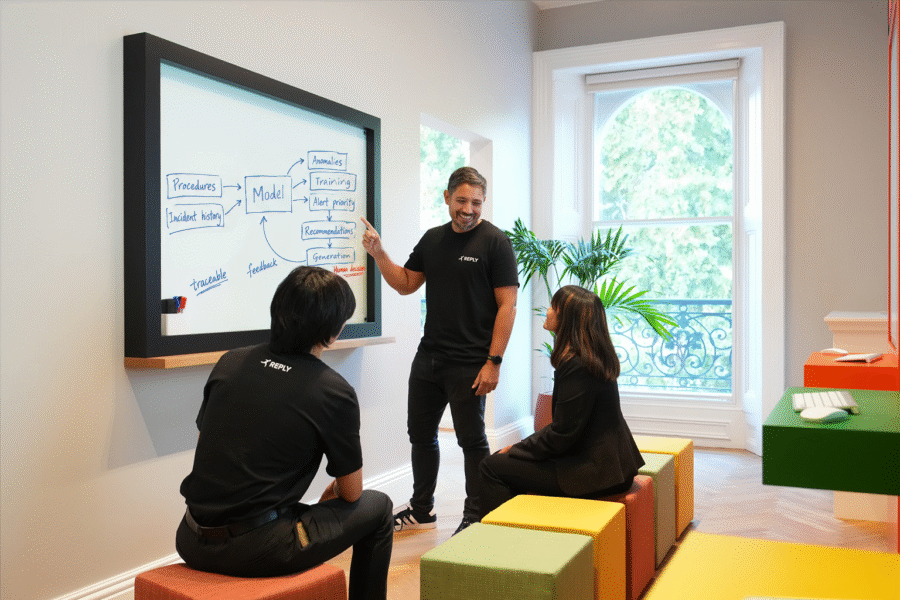
Clients and Reply specialists start from a concrete use case and co-design the model together.
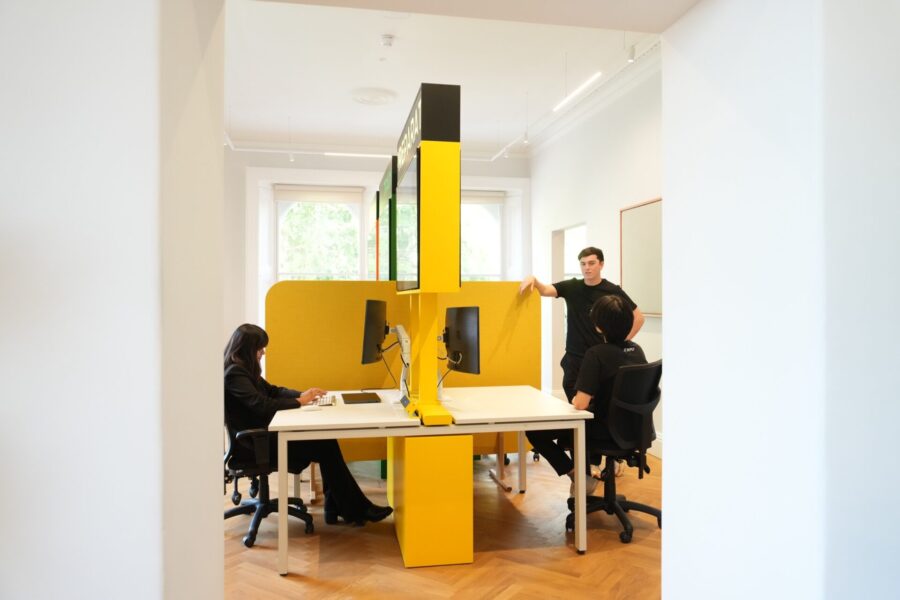
Each station makes a phase of the model lifecycle visible and operational.
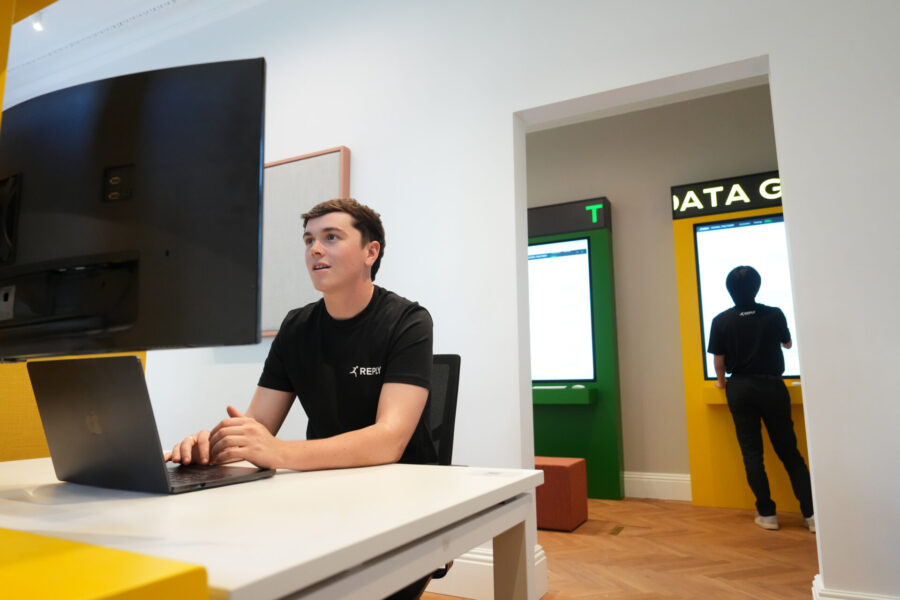
Proprietary data and domain knowledge become a governed, traceable and reusable AI asset.
Sometimes a general-purpose technology is simply too general. A general-purpose AI model – such as those behind ChatGPT or Claude – may be perfectly capable, but that doesn’t mean it is the right tool for every job. For businesses with valuable knowledge of their own, or those looking to automate at scale, there comes a point when adapting the technology to the task can make more sense than adapting the task to the technology.
Reply is bringing that approach to central London through its House of Models, based at Reply House London, the Group’s new UK headquarters. Designed as the physical entry point to the Model Factory, it is where clients work alongside Reply engineers to turn their own data and expertise into specialised AI models. Reply also operates a House of Models in Turin, creating two dedicated environments where clients can work directly with Reply across the full lifecycle of AI models.
According to Daniele Vitali, the partner at Reply who is leading the Model Factory,