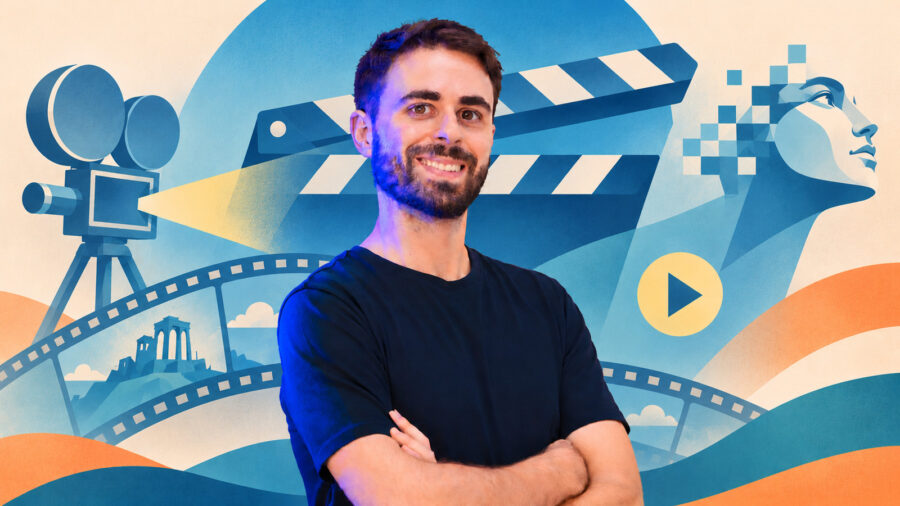
For years, Alex Marco had an entire film playing in his imagination. He knew the characters, the dialogue and every scene, and he’d written the screenplay and was ready to shoot. But the funding fell through.
“I had this story stuck in my head for five years and I basically made the movie in my head thousands of times,” he recalls. “All the characters that you saw, all the scenes, all the dialogues, they already existed in my head before AI.”
That screenplay eventually became Maria, Maria, a short film featuring entirely AI-generated characters. For Marco, co-founder of AI filmmaking studio The Blue Horizon, finally seeing his story on screen was deeply personal.
“For me, it’s like a dream,” he says.
Filmmaking had always been his passion, although marketing paid the bills. He wrote scripts and shot short films in his spare time, but struggled to break into the industry.
When generative AI video tools emerged, he began experimenting. Some of his creations went viral and he joined forces with three other filmmakers to establish The Blue Horizon.
The studio now produces advertising alongside original films, giving Marco a chance to pursue his cinematic ambitions while building a business around the technology.
From viral videos to brand campaigns
Marco says The Blue Horizon has expanded beyond its four founders to a team of about 10 people, including scriptwriters, visual-effects specialists and producers with experience in traditional entertainment. Its commercial work includes a Barbie launch film for Mattel and a Lynx advertisement for Unilever.
Marco is keen to challenge the impression that AI filmmaking requires little more than entering instructions into a computer.
“Sometimes people think that AI is just like a guy doing a random prompting in the laptop,” he says. “But there’s a lot of people behind it. There’s real human work. There is scripting. There is storyboarding. There is music that we produce ourselves.”
The studio combines AI tools with conventional production skills, including writing, editing and creative direction.
“The director is always going to be human,” Marco insists. “The choices are always going to be human. A machine is never going to be able to create a film from scratch without directors.”
For businesses, the appeal lies partly in producing elaborate scenes and effects without the expense of traditional sets and shoots. Marco also sees opportunities for smaller creative companies that previously lacked the resources to take on ambitious projects.
Asked whether AI filmmaking can provide a sustainable livelihood, rather than remaining a creative experiment, his answer is an immediate yes.
“It’s financially viable,” he says, for both films and commercials. “If done properly, of course.”
He believes the opportunity lies in combining technical expertise with the skills needed to produce work that clients and audiences will value.
Atlantis without a Hollywood budget
Marco’s ambitions go beyond advertising. Currently he is discussing a science-fiction project based on a screenplay he wrote seven years ago. Set in the lost world of Atlantis, it features aliens, elaborate environments and scenes that would be expensive to produce conventionally.
Marco estimates that a traditional production would require about $200m (£150m). He hopes AI could bring the cost below $5m (£3.7m). The project remains in discussion, and the figures are his estimates, but the potential difference in production costs explains much of his enthusiasm.
“One of the great things about AI is that it’s going to take a lot of great stories, great books, great mangas that were never adapted and never produced,” he says.
He believes lower production costs could allow independent filmmakers to pursue stories that previously struggled to attract investment.
“AI will never replace traditional films in the same way as CGI or animation films never replaced real films,” he argues. “You can think of AI film as a new genre.”
The business of consent
The use of AI in commercial productions also raises questions about ownership and consent, particularly when recognisable people appear on screen.
Some of The Blue Horizon’s films have depicted famous footballers in fictional situations. When asked about permission to recreate public figures, Marco points to the long history of celebrity impersonation and satire. He acknowledges, however, that increasingly realistic AI recreations require clearer boundaries.
“Because it’s becoming more realistic, a line needs to be drawn,” he says.
Marco says the studio is working on official collaborations with footballers including Erling Haaland, Marcus Rashford, Raphinha and Zinedine Zidane. He also points to emerging arrangements under which public figures could be compensated when their likenesses are recreated.
For brands, obtaining permission and ensuring audiences understand what they are watching are important considerations. Synthetic footage can be convincing enough to make a fictional appearance look like a genuine endorsement. Pressed on how studios can address this, Marco argues that disclosure is essential.
“Something that we do for all of our videos is we disclose that it is made with AI,” he says. “Instagram, YouTube, they all have a label and if you watch our videos you can clearly see made with AI.”
He is critical of companies that fail to acknowledge their use of AI.
“We are an AI film agency,” he says, “but everything we do, we’re happy to disclaim that it is AI, because we think that AI is just a tool like CGI.”
Disclosure is one consideration. Permission, compensation and creative freedom are others, particularly as filmmakers gain the ability to recreate recognisable people more convincingly. Marco believes AI studios should also bring experienced creative professionals into the industry.
“We are bringing traditional jobs to our studio,” he says. “Our studio is creating jobs, for example. We are creating stories that were never going to be told without AI.”
The problem with AI slop
Marco is equally candid about the quality of AI-generated content already circulating online.
“There is a lot of AI slop,” he admits. “And there are companies doing terrible ads with AI that are hated, and are hated with a great reason.”
For marketers, lower production costs are attractive, but quality remains essential. Unconvincing characters, unnatural movements and weak creative work can undermine even an ambitious campaign.Marco believes professional studios must spend time refining their productions rather than relying on the speed of AI generation.
“The key for that is to be totally obsessed,” he says. “If it’s not perfect, if it doesn’t look real, if it doesn’t express an emotion, if it doesn’t transmit something, we don’t make it live.”
He also rejects the suggestion that audiences cannot connect emotionally with synthetic characters. An admirer of Japanese animation, he points to Attack on Titan as an example of how fictional characters can move audiences.
“Why are you not gonna get emotional with a great story told with AI-generated humans?” he asks. “If you have doubts, I would say watch Maria, Maria and tell me if you don’t get any feeling.”
Despite building his business around AI, Marco remains devoted to conventional cinema.
“I’m a traditional cinema guy,” he says. “Even if I’m doing AI, I love the traditional cinema. I’ve shot films traditionally and that has a lot of magic and I love that.”
His ambitions include working with established directors and actors, producing feature films and eventually winning major cinema awards.
Cinema has always been about storytelling. Its methods have changed, but its ability to entertain and inspire has endured. The film Marco spent five years trying to make became his entry into filmmaking. He now has a studio of his own and more seemingly impossible scripts that he hopes will be brought to life soon.
For years, Alex Marco had an entire film playing in his imagination. He knew the characters, the dialogue and every scene, and he’d written the screenplay and was ready to shoot. But the funding fell through.
“I had this story stuck in my head for five years and I basically made the movie in my head thousands of times,” he recalls. “All the characters that you saw, all the scenes, all the dialogues, they already existed in my head before AI.”
That screenplay eventually became Maria, Maria, a short film featuring entirely AI-generated characters. For Marco, co-founder of AI filmmaking studio The Blue Horizon, finally seeing his story on screen was deeply personal.
